AI in Environmental Monitoring and Sustainability
Artificial intelligence (AI) is no longer a futuristic buzzword; it’s a practical tool that is reshaping how we monitor the planet and pursue sustainability. By leveraging machine learning (ML), deep learning, and advanced analytics, AI enables scientists and policymakers to collect richer data, detect subtle patterns, and predict ecological changes with unprecedented speed and accuracy.
Key AI Technologies Driving Change
- Satellite Remote Sensing – AI algorithms decode terabytes of imagery, identifying land‑cover shifts, deforestation, and glacial melt.
- Unmanned Aerial Vehicles (UAVs) – Equipped with high‑resolution cameras, drones provide granular, low‑altitude observations.
- Internet of Things (IoT) Sensors – Continuous streams of temperature, humidity, and pollutant data feed ML models in real time.
- Deep Neural Networks – Convolutional networks (CNNs) perform image classification while recurrent networks (RNNs) handle time‑series analysis.
- Edge Computing – Processes data locally on sensors or drones, reducing latency and bandwidth requirements.
These technologies together create a comprehensive, Near‑Real‑World (AI‑powered monitoring ecosystem) that powers most modern sustainability initiatives.
Applications in Environmental Monitoring
Air Quality
AI models sift through data from millions of low‑cost sensors and satellite platforms such as NASA’s TROPOMI to:
- Predict particulate matter (PM₂.₅) spikes with 95% confidence.
- Identify traffic‑related pollution sources in urban grids.
- Alert authorities to hazardous ozone levels before they reach unhealthy thresholds.
Water Quality
By analyzing spectral signatures from satellite imagery and sensor networks in rivers and lakes, AI can:
- Detect algal blooms early, enabling rapid response.
- Monitor pH, dissolved oxygen, and turbidity for aquaculture sustainability.
- Forecast flood‑water contamination levels, guiding evacuation plans.
Biodiversity
Deep learning, combined with camera trap footage, allows:
- Automating species identification down to the individual.
- Tracking population dynamics across vast protected areas.
- Predicting migration routes in response to climate shifts.
Climate Change
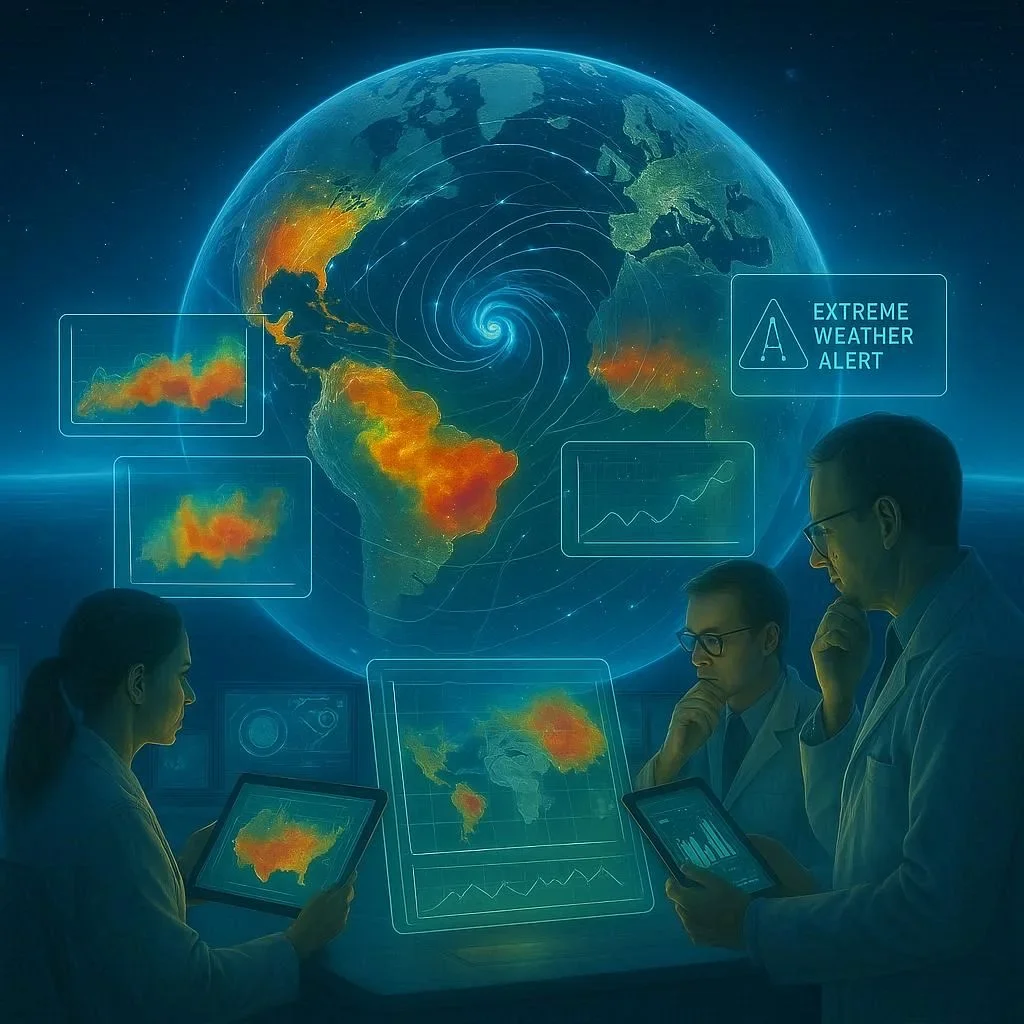
AI-driven climate models refine simulations of temperature, precipitation, and extreme weather events by:
- Incorporating high‑resolution data from Earth observation satellites.
- Reducing uncertainty in sea‑level rise projections.
- Enabling city‑scale carbon‑budget modeling for policy drafting.
Natural Disaster Prediction
With real‑time data streams from seismic sensors, radar, and satellite imagery, AI provides:
- Early warnings for hurricanes, wildfires, and tsunamis.
- Real‑time evacuation route optimization.
- Post‑disaster damage assessment to aid relief coordination.
Impact on Sustainability Goals
AI enhances the United Nations Sustainable Development Goals (SDGs) by:
- SDG 13 – Climate Action: Accurate forecasting of climate variability.
- SDG 14 – Life Below Water: Real‑time monitoring of ocean health.
- SDG 15 – Life on Land: Automated mapping of forest cover loss.
- SDG 3 – Good Health: Linking air and water quality to public health metrics.
According to the International Renewable Energy Agency (IRENA), AI‑augmented monitoring could reduce environmental waste by up to 30% through optimized resource management.
Challenges and Ethical Considerations
| Challenge | Potential Mitigation |
|—|—|
| Data Quality | Standardized protocols and open‑source datasets enable robustness. |
| Algorithmic Bias | Diverse training sets and explainable AI frameworks reduce discriminatory outcomes. |
| Privacy | Local data processing and anonymization protect individual privacy. |
| Cost & Accessibility | Cloud‑based AI platforms democratize access for developing regions. |
| Energy Consumption | Edge computing and efficient network architectures lower the carbon footprint of AI models. |
A responsible AI approach—aligned with the OECD Principles for AI—ensures that environmental monitoring technology is both effective and equitable.
Case Studies
NASA’s AI‑Powered Earth Observation
NASA’s “Planet Labs” partnership leverages CNNs to process daily satellite imagery, delivering rapid‑response maps of deforestation hotspots. Their open‑source toolbox (NASA Earthdata) has facilitated collaboration across 60+ institutions.
IBM’s Flood Prediction Platform
IBM’s Watson Decision Platform integrates IoT sensor data with historical flood records. The system predicts river overflow probability with a 70% accuracy margin, aiding municipalities in Spain and the United States.
Microsoft AI for Environmental Data
Microsoft’s AI for Earth program funds projects that use AI to conserve wildlife, manage water resources, and improve agricultural practices. Grants have supported over 400 projects, totaling more than $12 million in research credit.
Future Trends
- AI‑Integrated Autonomous Vehicles – Self‑driving ships and drones for comprehensive surveillance.
- Quantum‑Enhanced Machine Learning – Speeding up complex climate simulations.
- Hyper‑personalized Sustainability Dashboards – Real‑time alerts tailored to local communities.
- Global Data Commons – Shared open‑source datasets, encouraging collaborative AI innovation.
Where to Learn More
Conclusion & Call to Action
AI is accelerating the transition to a sustainable future by providing the tools to monitor, analyze, and act upon environmental data faster than ever before. Whether you are a policymaker, researcher, or a concerned citizen, understanding AI’s role in environmental stewardship empowers you to participate in proactive solutions.

100+ Science Experiments for Kids
Activities to Learn Physics, Chemistry and Biology at Home
Buy now on Amazon
Advanced AI for Kids
Learn Artificial Intelligence, Machine Learning, Robotics, and Future Technology in a Simple Way...Explore Science with Fun Activities.
Buy Now on Amazon
Easy Math for Kids
Fun and Simple Ways to Learn Numbers, Addition, Subtraction, Multiplication and Division for Ages 6-10 years.
Buy Now on Amazon