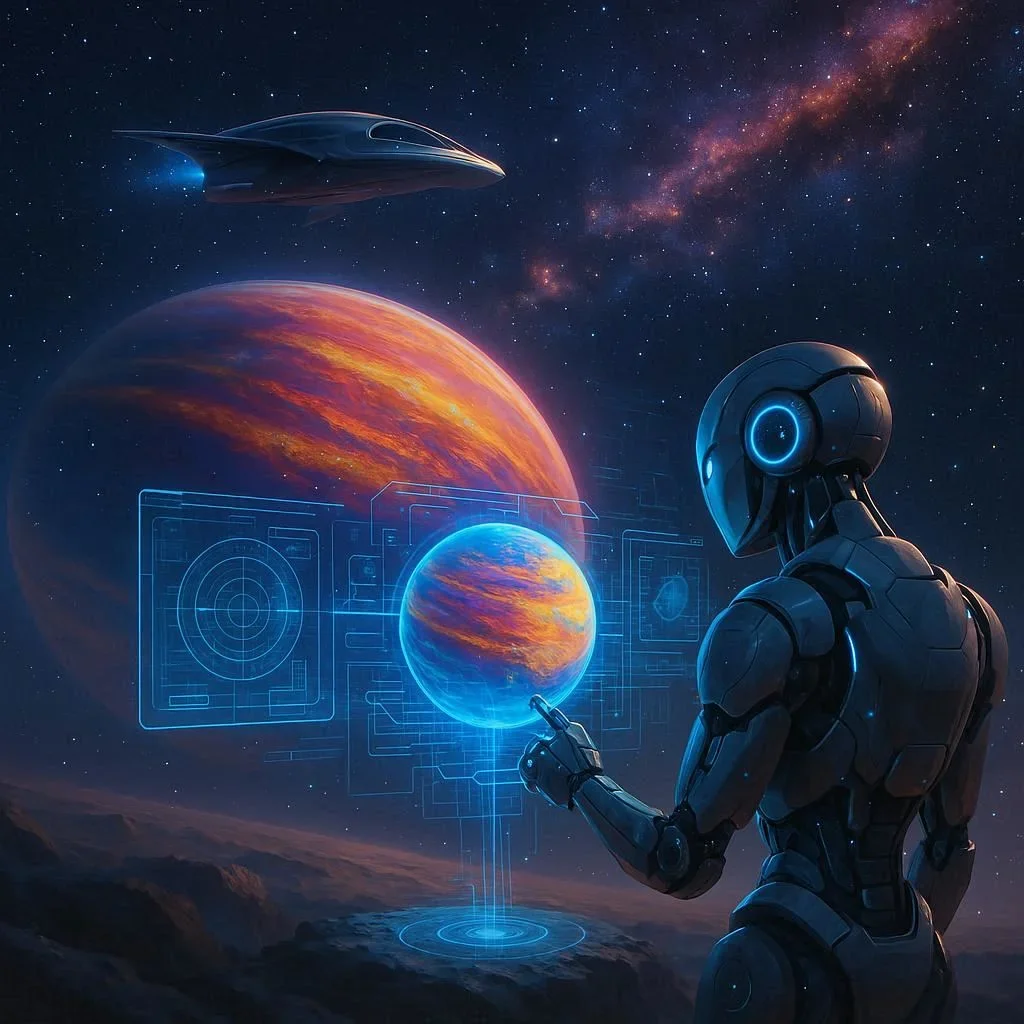
AI Enhances Asteroid Detection
The threat of near‑Earth objects demands swift, accurate detection and tracking. Artificial intelligence (AI) has become a game‑changer, turning vast sky‑survey data into timely alerts and precise orbit predictions. By filtering false positives, classifying objects, and automating follow‑up, AI reduces human workload and increases discovery rates. This article explores AI’s mechanisms, real‑world applications, and the next generation of planetary defense.
Machine‑Learning Pipelines for Sky Surveys
High‑cadence telescopes like Kepler and the upcoming Legacy Survey of Space and Time (LSST) generate terabytes of imaging each night. ML algorithms sift through this torrent, distinguishing moving asteroid trails from stationary stars and noise. Convolutional neural networks (CNNs) identify point‑like sources that drift, while decision‑tree ensembles filter out cosmic‑ray artifacts. This pipeline yields candidate asteroids in minutes, enabling rapid follow‑ups and orbit determinations.
AI‑Driven Orbit Determination and Prediction
Once a candidate surface is identified, the next challenge is to compute its trajectory with high precision. Traditional least‑squares methods struggle with sparse, noisy observations. Bayesian neural networks now incorporate observation uncertainties directly, producing probability density functions for orbital elements. These probabilistic orbits are fed into numerical propagators that forecast future positions, including potential Earth‑impact windows. Researchers at ESA have integrated such AI modules into the Planetary Defense Coordination Office’s warning system.
Real‑Time Risk Assessment with Deep Learning
Impact risk assessment relies on the Torino and Palermo scales, which require continuous data streams. Deep‑learning models ingest observational history, Yarkovsky drift measurements, and size estimates to update impact probability in real time. During the 2021 observation of Apophis, an AI system recalculated its impact probability within hours, alerting authorities and the public swiftly. The model’s ability to assimilate new data as soon as it arrives exemplifies AI’s role in mitigating the “last‑minute” uncertainty that often plagues planetary defense.
Combining Citizen Science and AI for Broader Coverage
Citizen‑science platforms such as TelescopeFeed allow amateur astronomers to upload images. AI triage first filters these contributions, flagging potential new objects for human review. A hybrid approach improves coverage: AI spots signals that would otherwise be missed, while human investigators provide contextual annotations that refine AI training. This continuous feedback loop enhances both discovery rates and model accuracy.
Challenges and Ethical Considerations
- Data Quality: Incomplete or biased training sets can lead to false positives.
- Explainability: High‑depth models may lack transparency, complicating trust in critical alerts.
- Resource Allocation: AI’s computational demands require sustainable infrastructure, especially for global real‑time pipelines.
Developers are addressing these concerns by adopting explainable AI (XAI) frameworks and investing in distributed cloud computing resources. Ethical AI guidelines, such as those outlined by the UN AI Ethics Framework, help ensure that monitoring systems remain fair, accountable, and transparent.
Future Directions: AI, Space Missions, and International Collaboration
Upcoming missions like NASA’s ASTEROPS will use AI to autonomously locate and rendezvous with near‑Earth asteroids. The mission’s AI will command spacecraft to adjust its trajectory for optimal observation angles, drastically reducing mission time. Moreover, AI will coordinate data from multiple observatories worldwide, creating a unified detection grid that mitigates regional blind spots.
Internationally, the UN Planetary Defense Conference has proposed shared AI training datasets and open‑source detection frameworks, ensuring that even nations with modest resources can contribute to global safety. This collaborative model underscores AI’s potential to democratize planetary defense.
Conclusion: AI is Our Front‑Line Guardian
Artificial intelligence is no longer an optional tool—it is the backbone of modern asteroid detection, orbit prediction, and risk mitigation. From machine‑learning pipelines that turn raw images into actionable alerts, to deep‑learning models that forecast impact probabilities in real time, AI is dramatically improving humanity’s preparedness for celestial threats. If you’re passionate about space, data science, or public safety, join the movement: contribute to research, support open‑source tools, and advocate for global AI‑enabled planetary defense. Let’s keep our planet safe together.
Frequently Asked Questions
Q1. How does AI improve asteroid detection rates?
AI algorithms can process far more images than a human observer, detecting faint moving objects in noisy data. By automating classification and filtering, AI increases discovery speed and reduces false positives, enabling timely follow‑ups.
Q2. What data does AI use to predict asteroid orbits?
AI models ingest positional measurements, observation uncertainties, and physical properties like size and albedo. Bayesian frameworks combine these inputs to produce probabilistic orbit predictions that update as new data arrive.
Q3. Are AI systems reliable for official impact warnings?
Yes, AI is integrated into international warning systems such as NASA’s Planetary Defense Coordination Office. These systems combine AI‑derived probabilities with human expert review to ensure accurate, timely alerts.
Q4. Can amateur astronomers help with AI‑based asteroid searches?
Absolutely. Citizen‑science platforms feed observations into AI triage systems, where AI flags candidates for further analysis. Amateur contributions increase sky coverage and model training data.
Q5. What ethical concerns exist around AI in asteroid defense?
Key concerns include data bias, lack of explainability, and computational resource demand. Addressing these involves transparent AI design, diverse training datasets, and international collaboration on shared infrastructure.
Related Articles

100+ Science Experiments for Kids
Activities to Learn Physics, Chemistry and Biology at Home
Buy now on Amazon
Advanced AI for Kids
Learn Artificial Intelligence, Machine Learning, Robotics, and Future Technology in a Simple Way...Explore Science with Fun Activities.
Buy Now on Amazon
Easy Math for Kids
Fun and Simple Ways to Learn Numbers, Addition, Subtraction, Multiplication and Division for Ages 6-10 years.
Buy Now on Amazon