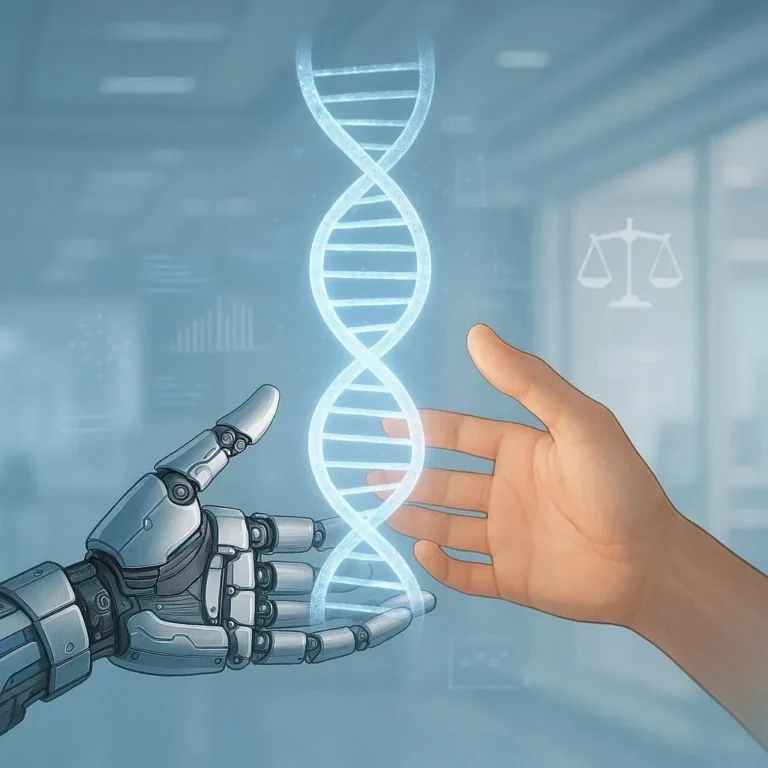
AI Human-Robot Collaboration
In today’s fast‑moving manufacturing landscape, the future of production hinges on seamless interaction between human workers and intelligent robots. The term AI Human‑Robot Collaboration describes this evolving partnership, where adaptive algorithms and sensor‑rich platforms empower both parties to reach new productivity heights. By integrating AI into collaborative robots, or cobots, companies can reduce downtime, improve quality control, and create safer work environments. This article delves into the technology, benefits, challenges, and emerging trends that are shaping this dynamic field.
Key Benefits for Modern Factories
AI Human‑Robot Collaboration offers a multi‑layered set of advantages. First, it enhances human safety; robots can detect human presence and dynamically adjust speed or trajectory to avoid collisions, a feature heavily promoted by the National Institute for Occupational Safety and Health (NIOSH). Second, productivity surges as cobots continuously learn from tasks, optimizing workflows and reducing the need for manual re‑programming. Third, quality consistency improves because sensor fusion and real‑time error detection enable instant adjustments, leading to fewer defects. These benefits collectively contribute to a competitive edge for manufacturers operating at scale.
- Safety: Real‑time perception of human position and intent.
- Efficiency: Adaptive path planning and fault‑tolerant execution.
- Quality: Continuous data validation and anomaly resolution.
- Cost Savings: Reduced labor hours and minimization of material waste.
Technological Foundations of AI Human‑Robot Collaboration
The core of this collaboration lies in the integration of AI, robotics, and human‑machine interfaces. Artificial Intelligence provides the decision‑making backbone, enabling robots to interpret unstructured environments and adjust task parameters on the fly (Artificial Intelligence). Coupled with high‑resolution cameras, laser scanners, and force sensors, these systems generate a rich perception model of the workspace. Moreover, machine‑learning algorithms train on vast datasets of human motion, using techniques such as reinforcement learning to develop optimal coordination policies.
Robotics hardware has evolved from rigid, isolated workcells to flexible cobot platforms that support collaborative tasks. Typical cobots feature compliant joints and low inertia, allowing safe physical interaction with workers. They also integrate cloud‑connected architectures so that updates, diagnostics, and performance metrics can be managed centrally, ensuring system consistency across large factory floors (Robotics). The convergence of these technologies transforms the traditional human‑robot relationship from a hand‑off process to a true partnership.
| Robot Type | Typical Tasks |
|---|---|
| Cobots | Assembly, pick‑and‑place, inspection |
| Mobile Robots | Material transport, inventory patrol |
| Stationary Robots | Welding, machining, packaging |
Implementation Challenges and Mitigation Strategies
Adopting AI Human‑Robot Collaboration is not without hurdles. Integration complexity arises from legacy machinery, data silos, and workforce readiness. To overcome hardware incompatibilities, manufacturers often employ modular adapters or retrofit kits that enable existing robots to interface with new AI layers. Data integration is addressed by implementing industrial IoT gateways, which normalize sensor streams into standard data formats and facilitate real‑time analytics.
Workforce concerns, such as job displacement fears, are mitigated through targeted training programs. Companies partner with universities, like the MIT Robotics Lab (MIT Robotics Lab), to develop curricula that equip workers with programming, data science, and troubleshooting skills. Furthermore, psychological safety is reinforced by participatory design sessions where employees provide feedback on robot interaction protocols, creating a sense of ownership and agency.
Regulatory compliance presents another obstacle. Industry standards such as ISO 10218 and the European Union’s Machinery Directive outline safety guidelines that AI‑enabled cobots must satisfy. Adhering to these frameworks requires rigorous software verification, including formal methods and runtime monitoring, to prove that autonomous behaviors do not violate safety constraints.
Future Trends Driving AI Human‑Robot Collaboration Forward
The horizon for AI Human‑Robot Collaboration is shaped by several exciting trends. First, the rise of edge computing will reduce latency, allowing robots to process visual and tactile data in real time without reliance on cloud connectivity. Second, advances in explainable AI will render robotic decision processes transparent, improving human trust and facilitating compliance audits.
Additionally, the integration of mixed‑reality overlays is expected to provide workers with intuitive guidance cues, enabling co‑creation of dynamic assembly lines. Finally, the convergence of AI Human‑Robot Collaboration with additive manufacturing will permit in‑situ prototyping, drastically shortening product development cycles.
These innovations hint at a future where factories operate as intelligent ecosystems, continuously learning, adapting, and collaborating across the workforce.
Take the next step towards AI Human‑Robot Collaboration and transform your production line into a smarter, safer, and more profitable enterprise. Contact our experts today to discover how your business can harness this technology.
Frequently Asked Questions
Q1. What types of tasks can AI Human‑Robot Collaboration handle on factory floors?
AI‑enhanced cobots can perform a range of tasks, including assembly, inspection, packaging, and material handling. Their adaptive algorithms allow them to adjust to variations in part geometry, tool wear, and human operator speed.
Q2. How does AI improve safety for workers interacting with robots?
Machine‑learning models analyze sensory input to detect human presence and predict trajectory, enabling robots to slow down or halt before a collision occurs. This proactive behavior aligns with safety standards such as ISO 10218.
Q3. Do I need to replace my existing robots to implement AI Human‑Robot Collaboration?
Not necessarily. Many manufacturers can retrofit legacy robots with AI modules and sensor upgrades. Compatibility depends on the robot’s control architecture and open‑interface capabilities.
Q4. What training is required for employees to work alongside AI‑enabled cobots?
Training typically covers basic programming, troubleshooting, and safety protocols. Some firms partner with academic institutions to offer courses on AI fundamentals and robotics programming.
Q5. Are there regulatory concerns with deploying autonomous robots in the workplace?
Compliance with industrial safety standards, such as ISO 10218 and the Machinery Directive, is essential. Manufacturers must conduct safety assessments and maintain documentation to demonstrate adherence to these regulations.
Related Articles

100+ Science Experiments for Kids
Activities to Learn Physics, Chemistry and Biology at Home
Buy now on Amazon
Advanced AI for Kids
Learn Artificial Intelligence, Machine Learning, Robotics, and Future Technology in a Simple Way...Explore Science with Fun Activities.
Buy Now on Amazon
Easy Math for Kids
Fun and Simple Ways to Learn Numbers, Addition, Subtraction, Multiplication and Division for Ages 6-10 years.
Buy Now on Amazon