Water Rocket Science: How to Build and Launch a High-Flying Bottle Rocket
Launching a rocket doesn’t require advanced technology or expensive fuel. With a plastic bottle, water, and air pressure, you can create a powerful water rocket that soars high into the sky. This classic backyard experiment is thrilling to watch and an excellent way to explore physics, motion, and basic engineering concepts in a hands-on way.
Whether you’re a student, teacher, or curious learner, building a water rocket is a fun introduction to real rocket science.
Why Water Rockets Are So Exciting
Water rockets clearly demonstrate how rockets work, using safe and simple materials.
- Newton’s Third Law in action: Thrust is created through equal and opposite forces
- Air pressure mechanics: Compressed air stores energy that powers launch
- Engineering fundamentals: Small design changes affect stability and height
- High-energy fun: Impressive launches without fire or fuel
It’s one of the best STEM experiments for learning through experience.
Materials Needed
Gather these basic items before starting:
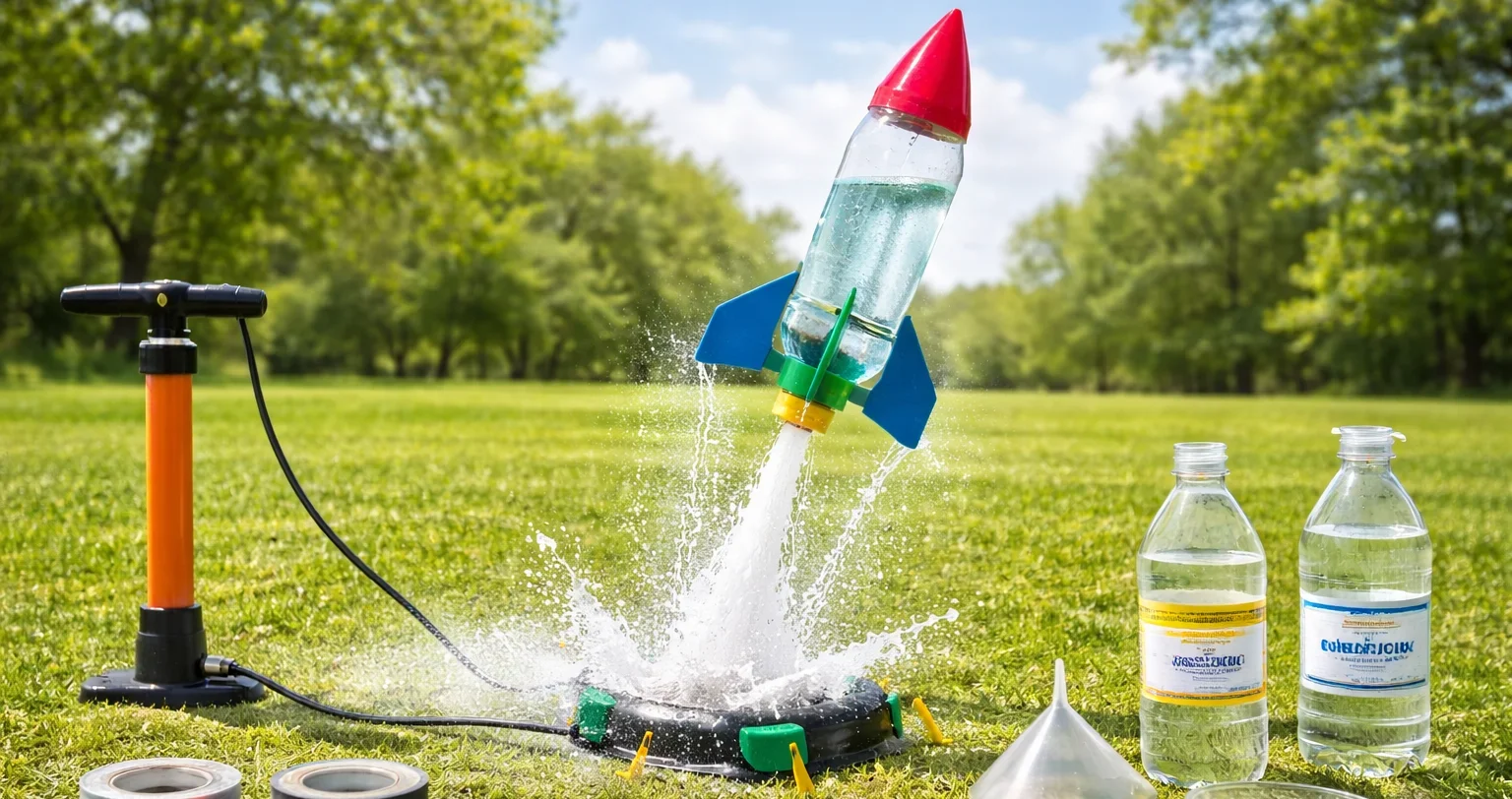
- Clean, empty 2-liter plastic soda bottle
- Water
- Rubber cork or stopper that fits tightly in the bottle mouth
- Bicycle pump with a needle adapter
- Cardboard or plastic fins (optional, for balance)
- Safety goggles
Make sure all materials fit securely to prevent air leaks.
Step-by-Step: How to Build a Simple Water Rocket
- Add water fuel
Fill the bottle about one-third full with water. This provides the mass needed for thrust. - Seal the opening
Insert the cork firmly into the bottle opening so it holds pressure. - Attach the pump
Push the needle adapter through the cork and connect it to the bicycle pump. - Improve stability (optional)
Tape fins evenly around the bottle for straighter, more controlled flight. - Position for launch
Turn the bottle upside down so the cork faces the ground and place it on a flat outdoor surface. - Build pressure and launch
Pump air into the bottle, step back, and watch as the cork releases and the rocket launches skyward.
How a Water Rocket Works
The science behind a water rocket is simple but powerful:
- Pumping air increases pressure inside the bottle
- Compressed air pushes forcefully on the water
- When pressure becomes too strong, the cork pops out
- Water shoots downward at high speed
- The reaction force propels the rocket upward
This is the same principle used by real rockets, just on a smaller scale.
Important Safety Guidelines
- Always launch in an open outdoor space
- Never point the rocket toward people, animals, or buildings
- Wear eye protection during setup and launch
- Stand clear once pressure starts building
Safety ensures the experiment remains fun and accident-free.
Fun Ways to Experiment Further
- Test different water levels to find the maximum height
- Add a lightweight nose cone for better aerodynamics
- Build a parachute to slow the descent
- Compare launches with and without fins
Each change helps explore how design affects flight performance.
Real-World Science Connection
Water rockets demonstrate real aerospace principles:
- Space rockets rely on the same action-reaction laws
- Engineers study thrust, drag, and stability just like this experiment
- Water rockets are widely used in STEM education and competitions
They offer a simple gateway into aerospace engineering and physics.
Final Thoughts
A homemade water rocket turns everyday materials into a powerful science lesson. It combines excitement with learning, showing how air pressure and motion work together to create flight. Best of all, it brings the wonder of rocketry right into your backyard.
The next time you see a rocket launch on the news, you’ll understand that the same physics powered your own high-flying experiment.

100+ Science Experiments for Kids
Activities to Learn Physics, Chemistry and Biology at Home
Buy now on Amazon
Advanced AI for Kids
Learn Artificial Intelligence, Machine Learning, Robotics, and Future Technology in a Simple Way...Explore Science with Fun Activities.
Buy Now on Amazon
Easy Math for Kids
Fun and Simple Ways to Learn Numbers, Addition, Subtraction, Multiplication and Division for Ages 6-10 years.
Buy Now on Amazon