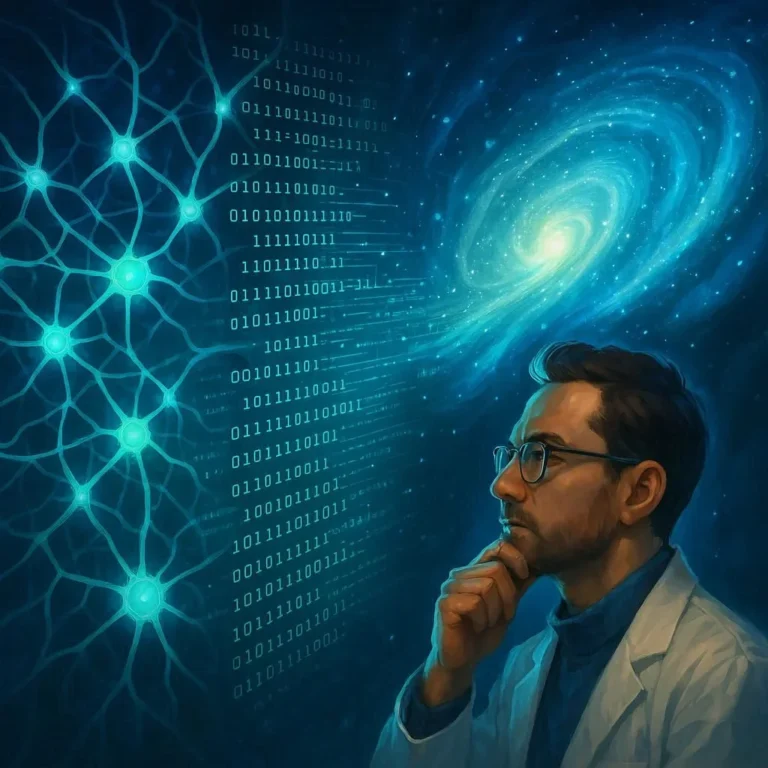
From Big Data to Big Bang
Modern astronomy is experiencing a transformation unlike anything seen before. For centuries, humans studied the universe by carefully observing small sections of the sky, recording what they could see through increasingly powerful telescopes. Today, that approach has evolved into something far more ambitious. Astronomers now collect enormous volumes of data that capture the universe in unprecedented detail, from nearby stars to galaxies billions of light-years away. This shift from traditional observation to data-driven discovery has given rise to a new era—one where big data and artificial intelligence (AI) work together to map the cosmos and deepen our understanding of the Big Bang itself.
The phrase “From Big Data to Big Bang” perfectly captures this journey. Massive sky surveys generate oceans of data, while AI helps scientists navigate and interpret it. Together, they allow researchers to trace cosmic structures, study galaxy evolution, and explore the earliest moments of the universe with remarkable precision.
The Rise of Big Data in Astronomy
Astronomy has always been observational, but the scale of modern observation is unprecedented. Advanced telescopes continuously scan the sky, capturing images and measurements across vast regions of space. Each night, these instruments generate more data than astronomers of the past could collect in a lifetime.
Large sky surveys systematically observe the universe rather than focusing on individual objects. They catalog millions of stars, galaxies, quasars, and cosmic events, creating detailed maps of the cosmos. These datasets include not only images but also information about brightness, distance, motion, and chemical composition. The result is a multidimensional view of the universe that reveals patterns invisible to smaller studies.
This explosion of astronomical data has fundamentally changed how research is conducted. Instead of asking narrow questions about individual objects, scientists can now study the universe statistically, identifying trends and structures that span billions of light-years.
Massive Sky Surveys: Mapping the Universe at Scale
Sky surveys are the backbone of modern cosmology. They aim to observe large portions of the sky in a systematic and repeatable way, ensuring that no region is overlooked. Famous observatories such as the Hubble Space Telescope laid the groundwork by delivering deep, high-resolution images of distant galaxies. Newer instruments have expanded this approach, collecting data at speeds and scales never before possible.
These surveys allow astronomers to build three-dimensional maps of the universe by measuring how light from distant objects has been stretched by cosmic expansion. By combining position and distance information, scientists can visualize the large-scale structure of the cosmos, often described as a vast “cosmic web” of galaxies and dark matter.
Mapping the universe at this scale is essential for testing theories about its origin and evolution. It provides direct evidence of how matter clustered after the Big Bang and how gravity shaped the universe over billions of years.
Why Big Data Alone Is Not Enough
While massive datasets are incredibly valuable, they also present a major challenge. The sheer volume of information makes manual analysis impossible. Even teams of expert astronomers cannot individually examine millions of galaxies or detect subtle patterns across enormous datasets.
This is where AI becomes indispensable. Artificial intelligence excels at finding structure in complexity. It can process vast amounts of data quickly, consistently, and without fatigue. By applying AI to astronomical datasets, scientists can extract meaningful insights that would otherwise remain hidden.
Without AI, much of the data collected by sky surveys would remain underused. With AI, it becomes a powerful tool for discovery.
How AI Helps Map the Cosmos
AI plays several critical roles in modern cosmology. One of its primary tasks is classification—sorting stars, galaxies, and other objects into meaningful categories. Machine learning algorithms analyze shapes, brightness patterns, and spectral signatures to identify different types of celestial objects with high accuracy.
Another major application is pattern recognition. AI can detect large-scale structures such as galaxy clusters, filaments, and voids within the cosmic web. These structures provide crucial evidence for how matter evolved after the Big Bang. AI systems can also identify rare or unusual objects that may challenge existing theories.
In addition, AI helps clean and refine data by removing noise, correcting errors, and filling in gaps. This preprocessing step is essential for ensuring that scientific conclusions are based on reliable information.
Connecting Big Data to the Big Bang
One of the most exciting aspects of combining sky surveys and AI is the ability to study the universe’s earliest moments. The Big Bang theory describes how the universe began as an extremely hot, dense state and expanded over time. Evidence for this theory is encoded in the large-scale distribution of matter we see today.
By analyzing massive datasets, AI helps astronomers trace how tiny fluctuations in the early universe grew into galaxies and clusters. These patterns allow scientists to test predictions made by cosmological models and refine estimates of fundamental parameters such as the universe’s age, composition, and expansion rate.
AI-driven analysis also supports studies of the cosmic microwave background, the faint radiation left over from the Big Bang. By combining this ancient signal with modern galaxy surveys, researchers can build a more complete picture of cosmic history.
Understanding Dark Matter and Dark Energy
Big data and AI are especially important for studying dark matter and dark energy, two of the most mysterious components of the universe. Although they cannot be observed directly, their effects shape the large-scale structure of the cosmos.
AI helps identify subtle gravitational distortions caused by dark matter, allowing scientists to map its distribution across space. Similarly, by analyzing how galaxies are distributed and how the universe’s expansion changes over time, AI contributes to our understanding of dark energy.
These studies are essential for explaining why the universe looks the way it does today and how it will evolve in the future.
Speed, Scale, and Scientific Discovery
The speed at which AI can analyze data has transformed astronomical research. Tasks that once took years can now be completed in days or even hours. This efficiency allows scientists to respond quickly to new discoveries and adapt their research strategies in real time.
AI-driven systems can also operate continuously, analyzing new data as it arrives. This capability is especially valuable for detecting transient events such as supernovae or unusual cosmic phenomena that require immediate attention.
By scaling analysis to match the scale of observation, AI ensures that no discovery is lost in the noise of big data.
Human Expertise and AI: A Collaborative Future
Despite its power, AI does not replace human scientists. Instead, it acts as a partner that enhances human capabilities. Astronomers design the surveys, define the scientific questions, and interpret the results. AI handles the heavy computational lifting, enabling researchers to focus on insight and theory.
This collaboration is essential for maintaining scientific rigor. Humans validate AI results, investigate unexpected findings, and ensure that conclusions align with physical laws. Together, humans and AI form a powerful team for exploring the universe.
The Broader Impact Beyond Astronomy
The techniques developed to analyze astronomical big data have applications far beyond space science. Image recognition, pattern detection, and data modeling methods originally designed for cosmology are now used in fields such as medicine, climate research, and artificial intelligence development itself.
In this way, efforts to understand the universe contribute to technological progress across society. Studying the cosmos drives innovation that benefits life on Earth.
The Road Ahead: Mapping the Universe in Greater Detail
As new observatories come online, the volume of astronomical data will continue to grow. Future sky surveys will capture deeper views of the universe, revealing objects closer to the dawn of time. AI will be essential for managing and interpreting this data deluge.
Upcoming research will likely integrate multiple data sources, combining optical, infrared, and radio observations into unified models of the cosmos. This holistic approach will provide a richer understanding of how the universe evolved from the Big Bang to the present day.
Conclusion
The journey from big data to the Big Bang represents one of the most exciting developments in modern science. Massive sky surveys provide the raw material—vast datasets that capture the universe in extraordinary detail. AI transforms this data into knowledge, uncovering patterns that reveal the universe’s structure, history, and fundamental laws.
Together, big data and AI are redefining how we explore the cosmos. By mapping the universe at unprecedented scale and depth, they bring us closer to answering humanity’s oldest questions: where did we come from, how did the universe begin, and what does its future hold?

100+ Science Experiments for Kids
Activities to Learn Physics, Chemistry and Biology at Home
Buy now on Amazon
Advanced AI for Kids
Learn Artificial Intelligence, Machine Learning, Robotics, and Future Technology in a Simple Way...Explore Science with Fun Activities.
Buy Now on Amazon
Easy Math for Kids
Fun and Simple Ways to Learn Numbers, Addition, Subtraction, Multiplication and Division for Ages 6-10 years.
Buy Now on Amazon