AI Accelerates Protein Folding
The intricate dance of amino acids forming precise three-dimensional protein structures remains one of biology’s most critical processes. For decades, scientists struggled to predict protein folding patterns through experimental methods like X-ray crystallography, which could take years per protein. Artificial intelligence has transformed this landscape dramatically, compressing what once took years into minutes while achieving unprecedented accuracy. This acceleration isn’t just a technical achievement – it’s unlocking revolutionary advances in drug discovery, disease understanding, and bioengineering.
The Protein Folding Challenge Explained
Protein folding refers to the complex physical process where chains of amino acids spontaneously arrange into functional 3D shapes. This biological origami determines protein function and its interactions within biological systems. Misfolding contributes to diseases like Alzheimer\u2019s, Parkinson\u2019s, and cystic fibrosis. Historically, scientists used techniques like cryo-electron microscopy\u2014which requires painstaking lab work\u2014to visualize protein structures. According to DeepMind’s research, we’ve spent decades solving only about 17% of human protein structures experimentally. This gap created a bottleneck in biomedical research where understanding form preceded understanding function.
How AI Predicts Structures Faster
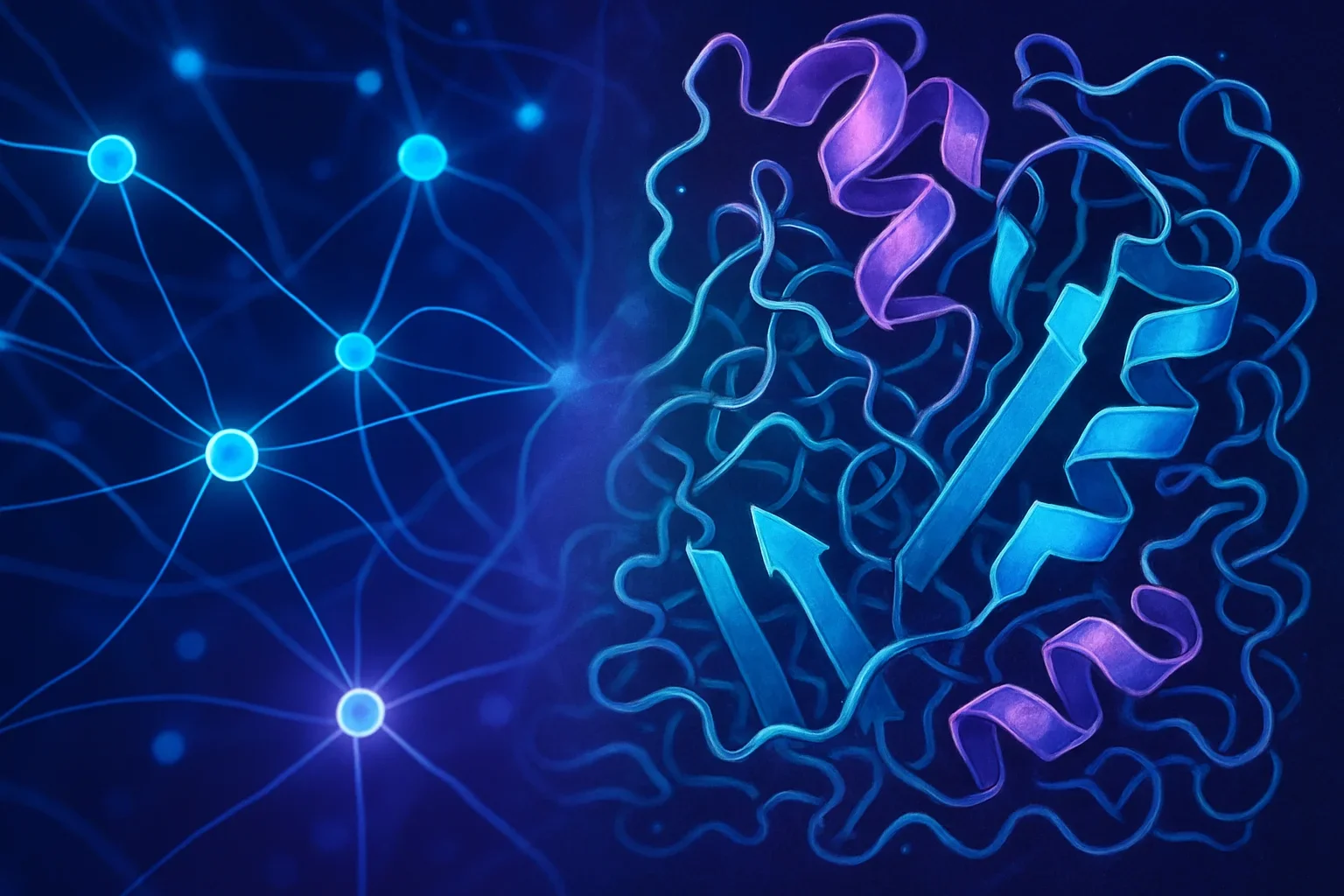
Modern AI systems accelerate protein folding through neural networks trained on vast biological datasets. These algorithms analyze evolutionary patterns across species using massive protein sequence databases. AlphaFold, an AI breakthrough from DeepMind, analyzes spatial geometries and residue-residue distances to predict atomic coordinates. Where traditional computational models tested countless possibilities sequentially, AI systems:
- Evaluate potential fold patterns in parallel
- Apply physics-based energy minimization
- Integrate structural priors from known templates
- Implement recurrent refinement mechanisms
The algorithm iteratively adjusts predictions so rapidly that a previously unsolved protein’s structure gets revealed within 24 hours \u2013 faster than wet lab experiments.
Breakthrough: AlphaFold’s Folding Revolution
The pivotal moment came when AlphaFold dominated the 2020 CASP14 competition – a specialized challenge for protein-structure prediction. It predicted structures with accuracy comparable to experimental methods. This landmark system now catalogs over 200 million protein structures freely available via the AlphaFold Protein Structure Database. These predictions aren’t opaque “black boxes” either; researchers can assess confidence levels throughout predicted models using per-residue confidence scores. As noted in Nature, AlphaFold represents “a solution to a 50-year grand challenge in biology” and symbolizes AI’s transformative potential in science.
Real Impacts: Practical Protein Applications
Accelerated protein folding empowers breakthroughs across biomedicine. Researchers leveraged these computational approaches to rapidly identify enzymes capable of digesting plastic waste \u2013 a discovery achieving mechanistic understanding that traditional screening couldn’t. In drug discovery, understanding binding sites expedites therapeutics creation: For instance, scientists deployed AI-generated spike protein maps to accelerate COVID-19 treatments. Medical fields benefitting include:
- Cancer biology by identifying mutated protein behaviors
- Genetic disease research clarifying functional impacts of mutations
- Antibiotic development by targeting bacterial proteins
- Synthetic biology designing novel enzymes for biofuels
As noted by researchers at NIH Clinical Center, shortening development pathways adds precious time against diseases.
Future Challenges and Opportunities
Despite progress, AI protein folding hasn’t solved all biochemical complexities. Challenges remain in predicting membrane proteins and complexes involving molecular movements. Initiatives like RoseTTAFold and NVIDIA\u2019s BioNeMo pursue solutions through hybrid physics\/AI approaches. The upcoming integration with cryogenic electron microscopy promises synergistic validation workflows. Emerging startups already build specialized pipelines around computational drug discovery; NIH\u2019s Strategic Plan for Data Science projects AI will halve drug discovery timelines within this decade. Ethical frameworks emerge alongside breakthroughs debating IP rights and equitable biotechnology access.
AI-powered protein folding marks a paradigm shift where computational insights accelerate experimental validation rather than follow it. From designing vaccines in pandemics to engineering biodegradable plastics, these algorithms solve structural mysteries that hindered biology for generations. This democratization of protein understanding fuels hope: We stand at the threshold of unprecedented discoveries addressing humanity’s pressing health and environmental challenges. Explore how scientists leverage accelerated protein folding to revolutionize medicine today.
Frequently Asked Questions
Q1. What is protein folding and why does speed matter?
Protein folding describes the process by which amino acid chains fold into functional 3D structures essential for biological activities. Speed matters because slow predictions delay medical discoveries. Accelerated understanding enables rapid therapeutic development for diseases ranging from cancer to genetic disorders.
Q2. How does AI achieve faster protein folding predictions?
AI analyzes evolutionary relationships and structural patterns using deep neural networks trained on millions of protein sequences. It evaluates folding probabilities simultaneously rather than sequentially, incorporating biochemical constraints to quickly generate accurate structure predictions.
Q3. What differentiates AlphaFold from previous models?
AlphaFold integrates graphical neural networks with attention mechanisms to map spatial relationships between amino acids accurately. Its novel gradient-based optimization outperforms prior systems by mimicking natural folding pathways rather than simple geometrical prediction.
Q4. Can AI predict all protein structure complexities?
Not yet. Challenges persist for intrinsically disordered proteins and intricate protein complexes. Current models sometimes struggle with conformational dynamics. Hybrid approaches combining experimental validation with predictive AI represent ongoing research frontiers.
Q5. How useful are AI-generated structures in laboratories?
Extremely useful. Researchers validate AI-predicted structures via crystallography or cryo-EM at approximately 90%+ success rates. These structures guide drug binding site identification, enzyme engineering, and molecular interaction studies that accelerate R&D timelines.

100+ Science Experiments for Kids
Activities to Learn Physics, Chemistry and Biology at Home
Buy now on Amazon
Advanced AI for Kids
Learn Artificial Intelligence, Machine Learning, Robotics, and Future Technology in a Simple Way...Explore Science with Fun Activities.
Buy Now on Amazon
Easy Math for Kids
Fun and Simple Ways to Learn Numbers, Addition, Subtraction, Multiplication and Division for Ages 6-10 years.
Buy Now on Amazon