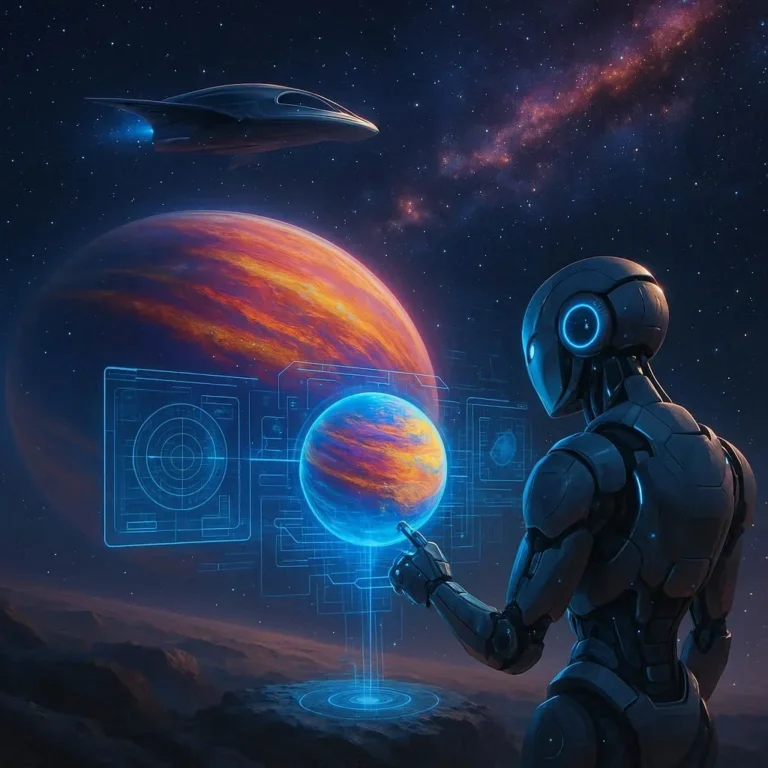

AI Running a Space Colony
Artificial intelligence is no longer confined to servers or smartphones; it is becoming an integral part of humanity’s ambition to explore, settle, and thrive beyond Earth’s atmosphere. Scientists and engineers are envisioning autonomous systems that can manage habitats, monitor resources, and respond to emergencies with precision and speed. The big question remains: could AI run a space colony effectively, ensuring safety, sustainability, and resilience for crews living in the harsh extraterrestrial environment?
AI in Habitat Automation
The cornerstone of any successful space colony is automated habitat management. AI can oversee structural integrity, temperature control, and airflow circulation, constantly adjusting parameters to maintain optimal living conditions. In a low-gravity environment, small deviations can amplify, risking structural failure; an AI system can predict and mitigate such risks before they become critical. Additionally, AI-driven robotics can perform maintenance tasks—replacing filters, inspecting panels, and calibrating instruments—without human intervention, freeing astronauts to focus on scientific research and community building.
Building a Space Colony with AI
Construction on the lunar surface or Mars involves complex logistical challenges, from transporting massive modules to assembling them in an isolated setting. AI-driven design tools can generate modular layouts that conform to local terrain and resource availability, optimizing material usage and minimizing waste. Autonomous construction robots, guided by machine‑learning algorithms, have already showcased the ability to lay foundations and erect structures with remarkable precision. With a sophisticated AI management layer coordinating these units, a colony can expand rapidly while maintaining safety standards.
AI Managing Life Support Systems
Life support on a space colony is a critical, failure‑critical system. AI can coordinate water recycling, oxygen generation, and waste processing in real time, adjusting flows according to crew size, activity levels, and potential leaks. Predictive analytics allow the system to pre‑emptively replace filters and adjust chemical scrubbers, reducing downtime and mitigating the risk of atmospheric contamination. By integrating sensor data from multiple subsystems, AI can detect anomalies that would otherwise require human visual inspection, thereby enhancing both reliability and crew well‑being.
AI Governance and Ethics
Beyond technical operations, a space colony demands governance structures that balance efficiency with ethical considerations. AI can serve as an impartial adjudicator, applying codified rules to address disputes, resource allocation, or emergency protocols. Yet this raises questions about accountability: who is responsible if an AI algorithm misjudges a life‑saving decision? Ethical frameworks must be embedded into the AI’s decision trees, ensuring transparency, explainability, and the ability for humans to override or audit critical choices.
Challenges and Limitations
Despite its promise, AI faces significant hurdles in extraterrestrial deployment. Communication latency between Earth and a lunar or Martian colony can reach several seconds to minutes, making real‑time control from Earth impractical. AI must therefore operate with high autonomy, making instant decisions without awaiting ground directives. Moreover, the harsh radiation environment can degrade both hardware and software, requiring radiation‑hard AI processors and robust error‑correction protocols. Finally, the current state of AI research still grapples with generalization—systems trained on Earth data may not behave predictably in the unique microgravity or thin‑atmosphere context of a colony.
Future Outlook
Looking ahead, collaboration between AI researchers, astronauts, and space engineers will shape the next generation of colony management systems. Adaptive machine learning models can incorporate real‑world data from early prototypes, continuously improving performance. Advances in edge computing and low‑power neural processors will reduce reliance on Earth‑based servers, making space‑specific AI hardware a reality. As regulatory bodies and international space agencies develop guidelines, AI will play a pivotal role in ensuring that colonies are not only habitable but also governed equitably and sustainably.
Conclusion: Embrace AI for Space Domination—AI stands poised to bridge the gap between human aspiration and the technical demands of living on another planet. By automating habitat management, construction, life support, and governance, AI can provide the resilience and efficiency required for successful space colonies. The future of humanity beyond Earth hinges on our ability to harness intelligent systems that can learn, adapt, and protect. Invest in AI research today, and join the trailblazers who will bring our species a step closer to becoming a multi‑planetary civilization.
Frequently Asked Questions
Q1. What level of autonomy do AI systems need to run a space colony?
AI must be highly autonomous, capable of making immediate decisions without awaiting Earth‑based input. This involves real‑time data processing, emergency response capabilities, and the ability to adjust operations based on localized conditions.
Q2. How can AI contribute to the safety of astronauts in a colony?
By continuously monitoring environmental parameters, predicting equipment failures, and automating maintenance tasks, AI reduces manual workload and mitigates risks associated with human error in high‑stakes scenarios.
Q3. Are there ethical concerns with delegating governance to AI?
Yes, AI governance requires transparent decision algorithms, clear accountability mechanisms, and the ability for human override, especially for life‑threatening or resource‑critical situations.
Q4. What technical challenges must be overcome to deploy AI on Mars?
Challenges include ensuring radiation‑hard hardware, managing communication latency, and adapting AI models trained on Earth data to the Martian environment’s unique conditions.
Q5. How soon might we see AI‑managed colonies on the Moon or Mars?
While exact timelines are uncertain, the rapid advancement of autonomous robotics and AI edge computing suggests that we could see pilot projects within the next decade, with larger scale colonies following as technology matures.

100+ Science Experiments for Kids
Activities to Learn Physics, Chemistry and Biology at Home
Buy now on Amazon
Advanced AI for Kids
Learn Artificial Intelligence, Machine Learning, Robotics, and Future Technology in a Simple Way...Explore Science with Fun Activities.
Buy Now on Amazon
Easy Math for Kids
Fun and Simple Ways to Learn Numbers, Addition, Subtraction, Multiplication and Division for Ages 6-10 years.
Buy Now on Amazon