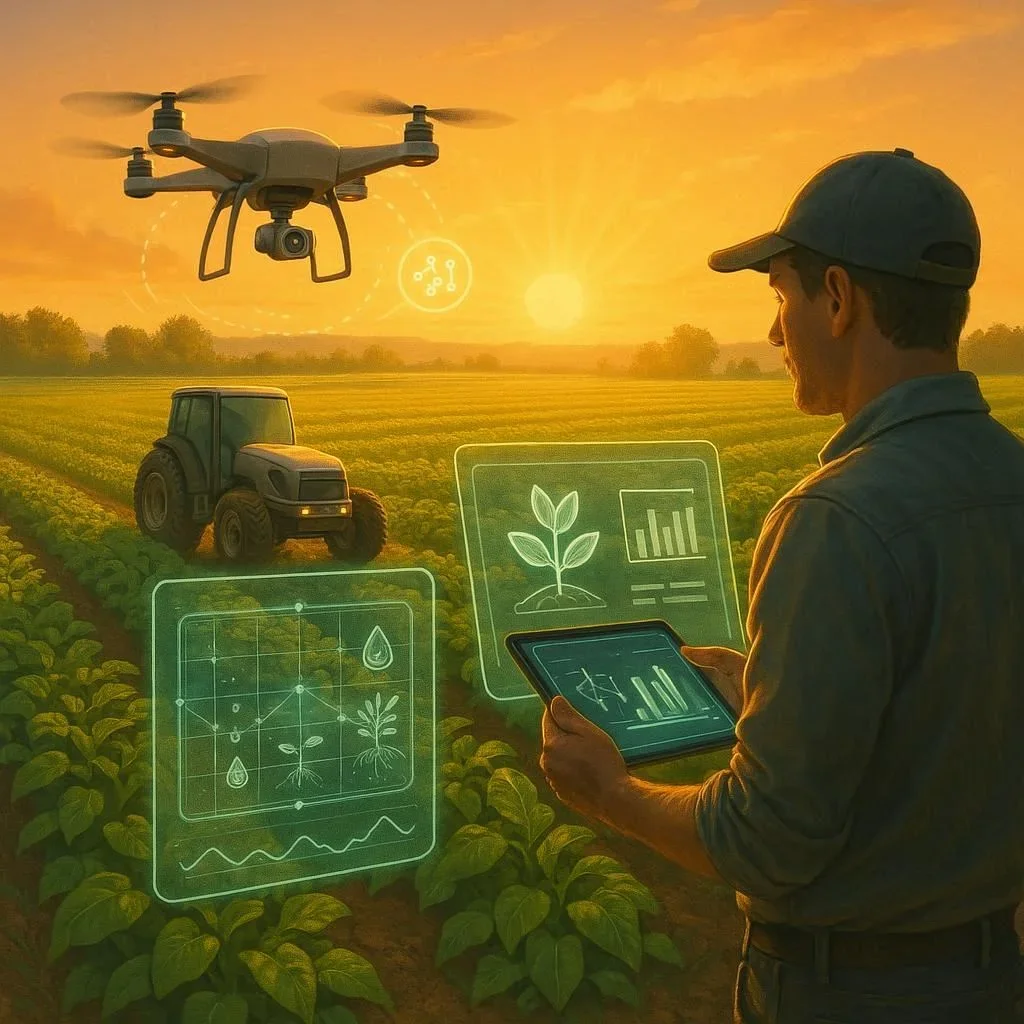
AI in Agriculture: Precision Farming Innovations
Precision farming has moved beyond simple GPS coordinates and now relies on real‑time data, advanced algorithms, and autonomous machines to boost productivity while conserving resources.
1. Data‑Driven Crop Monitoring
Farmers now deploy AI sensors across fields to capture micro‑climate data—soil moisture, temperature, and nutrient levels. These sensors feed into machine‑learning models that:
- Detect stress early, allowing targeted interventions.
- Optimize fertiliser and pesticide use.
- Improve overall crop resilience.
The USDA reports that precision irrigation saves up to 30 % of water when managed by AI‑powered systems. For more on how data is revolutionising agriculture, see the Wikipedia article on precision agriculture
2. Autonomous Machinery
Self‑driving tractors and harvesters exemplify AI’s impact on field operations. Algorithms interpret feed‑forward data from GPS, LIDAR, and high‑resolution cameras to perform tasks such as:
- Plowing and seeding with centimeter‑level precision.
- Weed control using targeted spray mechanisms.
- Harvest timing based on real‑time ripeness detection.
Nature’s case study on autonomous tractors illustrates how AI can reduce labour costs by up to 20 %.
3. Remote Sensing and Satellite Imaging
Satellite platforms like Sentinel‑2 and Planet provide high‑resolution imagery that, when combined with AI, can:
- Generate detailed NDVI maps.
- Identify disease hotspots.
- Track crop growth stages over large areas.
These insights help farmers allocate resources efficiently. The FAO’s Digital Farming initiative highlights the importance of satellite data for monitoring global food security.
FAO on digital farming technologies
4. Predictive Analytics for Yield
Machine‑learning models that ingest historical production data, weather forecasts, and genomic information predict crop yields with 95 % accuracy in trials. Accurate yield forecasts allow:
- Better market positioning.
- Optimised storage and logistics planning.
- Reduced post‑harvest waste.
Researchers at the University of California, Davis, have released an open‑source toolkit that enables smallholders to build custom predictive models.
UC Davis Precision Agriculture Program
5. Precision Irrigation
AI‑driven irrigation systems adjust water flow based on real‑time sensor data, micro‑climate models, and evapotranspiration estimates. Benefits include:
- Water savings of up to 40 % in trials.
- Lower energy use for on‑site pumps.
- Reduced runoff and soil erosion.
The Water Research Institute reports that AI‑enhanced irrigation has a payback period of less than two years.
6. AI‑Powered Pest Management
Smart insect traps equipped with image recognition can identify pest species and quantify densities. Coupled with AI‑based decision rules, farms can:
- Apply pesticides only where needed.
- Reduce chemical residue on produce.
- Lower environmental footprints.
A leading agri‑tech firm’s pilot project in Nebraska achieved a 30 % reduction in pesticide usage.
7. Blockchain and Traceability
Integrating AI with blockchain creates immutable records of every farm action—seed variety, fertiliser application, harvest dates—enhancing traceability and consumer trust. AI can also:
- Detect anomalies in supply chains.
- Predict risk of contamination.
- Facilitate rapid recall management.
W3C on blockchain for agriculture
8. Challenges and Ethical Considerations
Despite the benefits, AI‑driven precision farming faces:
- Data privacy risks: Farmers must safeguard sensitive field data.
- Digital divide: Smallholders may lack access to the necessary hardware.
- Algorithmic bias: Models trained on limited datasets can misrepresent local conditions.
- Ecosystem impact: Concentrating resources on high‑yield varieties could reduce biodiversity.
Governments and NGOs are developing standards to address these concerns.
9. Future Outlook
Looking ahead, integration of AI with emerging technologies—5G connectivity, edge computing, and quantum‑enhanced sensors—will further accelerate the precision farming revolution. Key trends include:
- Hyper‑local weather modelling for micro‑climate optimisation.
- AI‑enabled vertical farms reaching urban centres.
- Robotic livestock monitoring for early disease detection.
The global market for precision agriculture is projected to hit US$ 47.9 billion by 2030, driven largely by AI innovations.
Conclusion & Call to Action
AI in agriculture is not just a technological upgrade—it is a pathway to sustainable, resilient, and profitable farming. By adopting AI-driven precision tools, farmers can:
- Increase yields by up to 15 % in some crops.
- Reduce input costs by 20‑30 %.
- Contribute to climate‑positive agriculture.
If you’re ready to transform your fields, explore AI solutions today. Download our free AI‑in‑Ag guide, sign up for a demo, and join the precision farming revolution.
*Ready to innovate? *Email us at info@agriai.com for a personalised farm assessment.*

100+ Science Experiments for Kids
Activities to Learn Physics, Chemistry and Biology at Home
Buy now on Amazon
Advanced AI for Kids
Learn Artificial Intelligence, Machine Learning, Robotics, and Future Technology in a Simple Way...Explore Science with Fun Activities.
Buy Now on Amazon
Easy Math for Kids
Fun and Simple Ways to Learn Numbers, Addition, Subtraction, Multiplication and Division for Ages 6-10 years.
Buy Now on Amazon