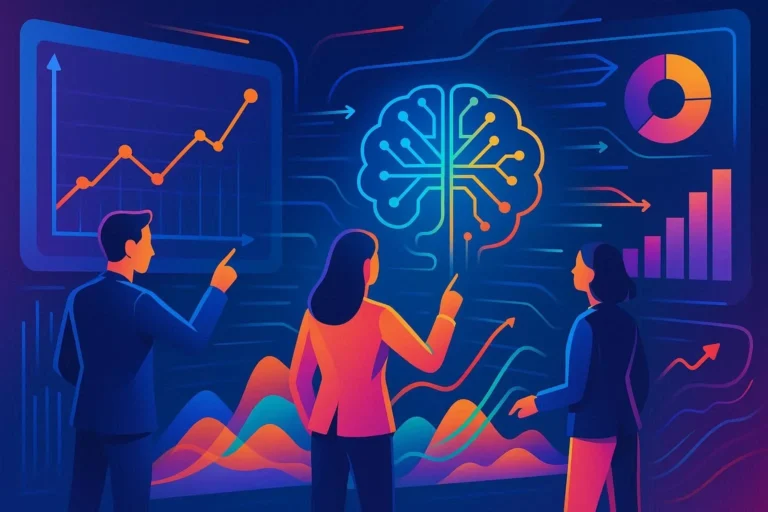
AI-Powered Financial Forecasting Models
Introduction: The Rise of AI in Financial Forecasting
AI‑powered financial forecasting has moved from a niche research topic to a mainstream business imperative. Traditional statistical models, such as ARIMA or exponential smoothing, rely on strict assumptions about seasonality and linearity that often fail in volatile markets. Machine learning, especially deep learning, removes many of those constraints, allowing models to automatically uncover complex patterns from massive data streams.
Check out the foundational concepts in our in‑depth guide on Financial Forecasting on Wikipedia. These resources illustrate how AI is redefining the accuracy and speed of predictive analytics across finance.
Core Components of AI‑Powered Forecasting Models
Data Collection & Preparation
- Real‑time market feeds: Stock exchanges, forex, and commodities provide high‑frequency time‑series data.
- Alternative data: Social media sentiment, satellite imagery, and credit‑card transactions enrich the feature set.
- Cleaning & normalization: Removing outliers, handling missing values, and aligning time stamps are critical before training.
Feature Engineering & Selection
- Lagged variables: Past values of the target variable capture temporal dependencies.
- Rolling statistics: Moving averages, volatility measures, and percent‑change rates provide context.
- External regressors: Macro‑economic indicators (GDP, CPI) help capture systematic trends.
Model Architecture
Deep learning models, such as Long Short‑Term Memory (LSTM) networks and Temporal Convolutional Networks, excel at capturing nonlinear dynamics and long‑range dependencies. Hybrid approaches combine ARIMA residuals with neural nets for improved interpretability.
Training, Validation, and Hyperparameter Tuning
Use time‑series cross‑validation (rolling or expanding windows) to prevent look‑ahead bias. Grid search, Bayesian optimization, or evolutionary algorithms fine‑tune hyperparameters like learning rate, hidden layer size, and dropout rates.
Practical Implementation Steps
Choosing the Right Algorithm
| Algorithm | Strength | Use‑Case |
|———–|———-|———-|
| ARIMA | Simple & fast | Short‑term forecasting |
| LSTM | Nonlinear, long memory | Stock price & volatility |
| Prophet | Handles seasonality & holidays | Retail & e‑commerce |
| Transformer | Attention‑based, scalable | Macro‑economics forecasting |
Building a Robust Data Pipeline
Integrate data ingestion with tools like Apache Kafka, stream processing frameworks, and cloud storage (AWS S3, GCP BigQuery). Automation ensures that newly harvested data flows directly into the training pipeline without manual intervention.
Deploying in Production
- Containerization: Docker images encapsulate model environments.
- Model serving: TensorFlow Serving or ONNX Runtime provide low‑latency inference.
- Monitoring: Track performance metrics (MAE, RMSE) over time and trigger alerts when drift is detected.
Accuracy & Performance Metrics
Objective evaluation is essential. Common metrics include:
- Mean Absolute Error (MAE): Captures average deviation.
- Root Mean Squared Error (RMSE): Penalizes larger errors heavily.
- Mean Absolute Percentage Error (MAPE): Useful for comparing across scales.
Additionally, consider domain‑specific metrics such as Sharpe ratio improvements or value‑at‑risk reductions when assessing trading strategies.
Case Studies & Real‑World Applications
Stock Market Prediction
High‑frequency trading firms employ LSTM networks to predict intraday price movements with microsecond latency, combining technical indicators with news sentiment feeds.
Credit Risk Assessment
Banks integrate AI forecasting to model portfolio loss over the next quarter. Gradient‑boosted trees uncover subtle correlations between borrower behavior and macro‑economic shocks.
Macro Forecasting
Central banks use transformer‑based models to forecast GDP growth, CPI, and unemployment rates, allowing policymakers to adjust policy levers proactively.
For an illustrative walk‑through, consult the MIT Sloan research on AI in finance, which showcases several of these applications.
Challenges and Ethical Considerations
Data Quality and Bias
Even advanced models can amplify existing biases if the training data is skewed. Rigorous auditing of data sources and feature importance analysis mitigates this risk.
Regulatory Compliance
Financial institutions must navigate regulations such as GDPR in the EU, Basel III for risk management, and the SEC’s guidance on AI usage. Models should be auditable and transparent to satisfy regulators.
Explainability & Transparency
Stakeholders demand explanations for model predictions. Techniques like SHAP values, LIME, or rule‑based approximations help demystify complex deep nets.
Future Trends in AI Financial Forecasting
Explainable AI (XAI)
Machine learning companies are releasing frameworks that produce human‑readable explanations, making AI more trustworthy.
AutoML & Neural Architecture Search
AutoML platforms can optimize model architecture with minimal human involvement, accelerating deployment cycles.
Quantum Computing & Edge AI
Quantum algorithms promise exponential speed‑ups for certain optimization problems, while edge devices enable real‑time data analysis at the source.
Conclusion and Call to Action
AI‑powered financial forecasting is reshaping the decision‑making landscape across sectors. From retail demand forecasting to sovereign risk assessment, these models deliver tangible value by improving accuracy, reducing latency, and uncovering hidden patterns.
If you’re ready to elevate your forecasting capabilities, start by:
- Assessing data readiness—extract high‑quality, diverse data streams.
- Experimenting with model prototypes—explore LSTM or transformer architectures.
- Implementing rigorous monitoring—detect drift early and maintain performance.
Join the conversation: share your experiences, challenges, or breakthroughs in the comments below or on our Investopedia community. Let’s push the frontier of financial forecasting together.

100+ Science Experiments for Kids
Activities to Learn Physics, Chemistry and Biology at Home
Buy now on Amazon
Advanced AI for Kids
Learn Artificial Intelligence, Machine Learning, Robotics, and Future Technology in a Simple Way...Explore Science with Fun Activities.
Buy Now on Amazon
Easy Math for Kids
Fun and Simple Ways to Learn Numbers, Addition, Subtraction, Multiplication and Division for Ages 6-10 years.
Buy Now on Amazon