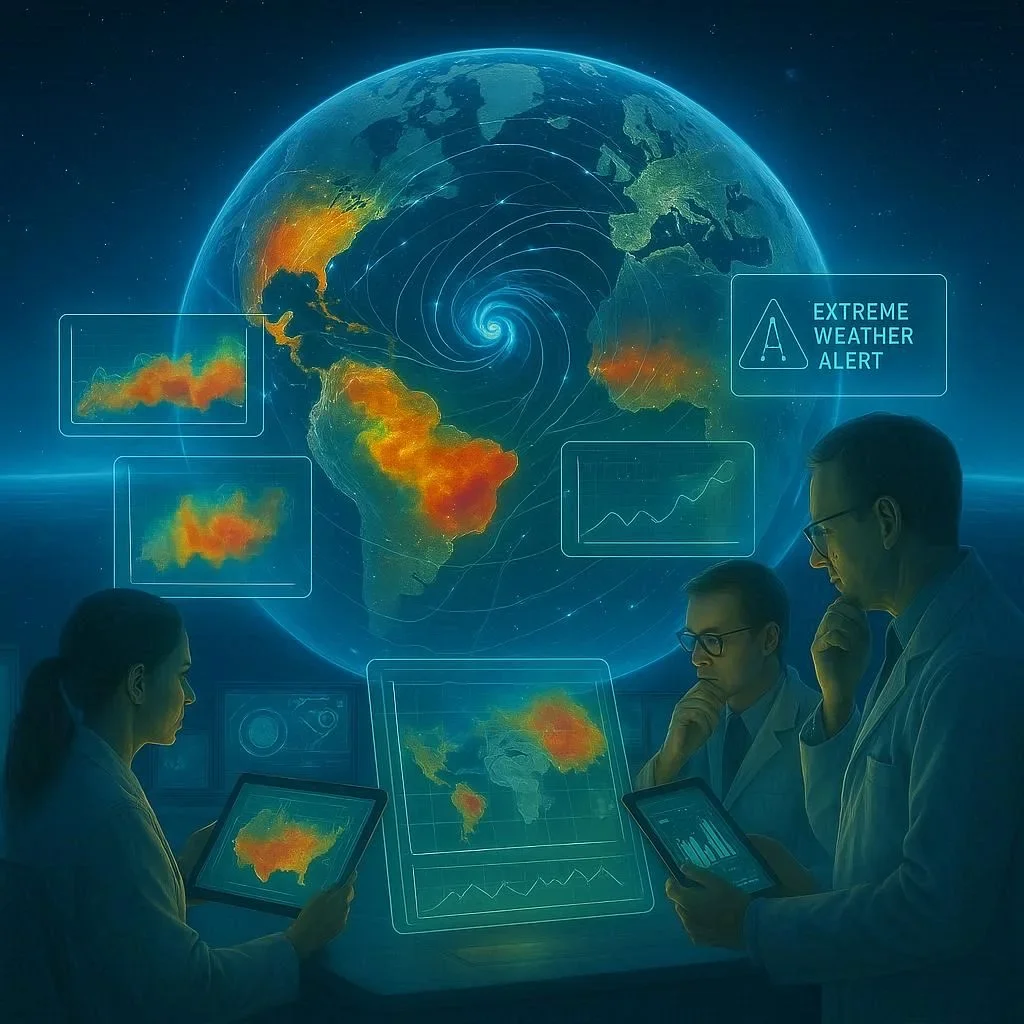
Machine Learning for Environmental Monitoring
Machine learning (ML) has become the cornerstone of modern environmental monitoring. By parsing vast amounts of sensor data, satellite imagery, and field observations, ML models can detect subtle patterns that human analysts often miss. In this post, we explore how ML is revolutionizing environmental monitoring, highlight real‑world case studies, and outline practical steps for eco‑technologists eager to harness these powerful tools.
The Intersection of AI and Ecology
The environmental sciences have historically relied on statistical models that, while robust, struggle with high‑dimensional, non‑linear data. Machine learning steps in to:
- Handle complex, noisy datasets sourced from IoT sensor networks, remote‑sensing platforms, and citizen‑science initiatives.
- Extract spatial and temporal patterns across large geographic areas and long time horizons.
- Predict critical events—such as floods, forest fires, or coral bleaching—with higher confidence.
According to a 2023 review in Science Advances, ML has improved predictive accuracy by up to 30 % for many ecological forecasting tasks[^1].
Core Machine Learning Techniques in Environmental Monitoring
| Technique | Typical Use | Example Applications |
|———–|————-|———————-|
| Supervised regression | Predict continuous variables | Air‑quality index, soil moisture |
| Classification | Categorize discrete states | Land‑cover changes, species identification |
| Anomaly detection | Spot outliers | Ocean temperature spikes, sensor faults |
| Unsupervised clustering | Reveal hidden groupings | Habitat segmentation, climate regime clustering |
| Deep learning (CNN, RNN) | Process high‑dimensional data | Satellite image analysis, weather pattern recognition |
Data Sources and Pre‑Processing
- Remote sensing satellites – NASA’s Landsat 8 (USGS), ESA’s Sentinel‑2, or commercial platforms like PlanetScope.
- Ground‑based sensors – Netatmo weather stations, AirQo, PurpleAir (air‑quality)
- Citizen‑science networks – eBird, iNaturalist, #WeObserve.
- Legacy datasets – NOAA’s climate normals, WorldClim.
Pre‑processing steps typically involve:
- Georeferencing & co‑registration to align datasets.
- Missing‑value imputation using k‑NN or interpolation.
- Normalization (z‑scores, min‑max scaling) for algorithm stability.
- Feature engineering – e.g., deriving vegetation indices (NDVI) from spectral bands.
Model Selection and Validation
Start with baseline models (e.g., Random Forests) before moving to more complex architectures. Cross‑validation (k‑fold, time‑series split) ensures models generalize beyond training data. Performance metrics vary by task:
- R² / RMSE for regression.
- Accuracy / F1‑score / AUROC for classification.
- Precision / Recall for anomaly detection.
Deployment: From Model to Monitor
- Edge computing: Deploy lightweight models on Raspberry Pi or Arduino‑based sensors for real‑time alerts.
- Cloud platforms: Use AWS SageMaker, Google AI Platform, or Azure ML for scalable training and inference.
- API integration: Expose predictions via RESTful APIs for downstream dashboards (e.g., ArcGIS Online, Tableau).
Real‑World Success Stories
1. Predicting Floods in the Amazon Basin
Researchers at the University of São Paulo used a Long Short‑Term Memory (LSTM) network trained on gauge data, radar rainfall, and evapotranspiration metrics. The model achieved an 85 % accuracy in predicting peak flood levels 24 hours in advance, substantially enhancing early‑warning systems for local communities.
2. Air‑Quality Forecasting in Urban Centers
The AirQo platform integrates data from >200 low‑cost sensors across Nairobi and uses Gradient Boosting Machines to forecast PM₂.₅ levels up to 48 hours ahead. This allows city planners to issue health advisories and adjust traffic routing.
Environmental monitoring (Wikipedia) provides a concise overview of such urban air‑quality initiatives.
3. Coral Reef Health Assessment
A partnership between NOAA and Stanford University combined satellite imagery with deep convolutional neural networks (CNNs). The system could identify bleaching events with 90 % precision, enabling rapid response by marine biologists.
Nature study on ML for coral reef monitoring details the underlying methodology.
Challenges and Ethical Considerations
| Challenge | Mitigation Strategies |
|———–|————————|
| Data bias | Ensure diverse sensor placement; incorporate citizen‑science data from under‑represented regions |
| Model interpretability | Use SHAP or LIME visualizations; prioritize simpler models where decision transparency is critical |
| Privacy concerns | Anonymize datasets; adhere to GDPR and local data protection laws |
| Resource constraints | Leverage transfer learning; opt for federated learning to keep data on edge devices |
The UN Sustainable Development Goals (SDG 13 – Climate Action)^2 underscore the importance of equitable data collection and open‑source model sharing to guarantee that all communities benefit from technological advances.
Steps to Get Started with ML in Environmental Monitoring
- Define the ecological question – e.g., imminent wildfire risk, species distribution, or pollutant dispersion.
- Gather relevant datasets – combine satellite, ground‑based, and crowdsourced data.
- Choose a suitable ML framework – scikit‑learn for baseline models, TensorFlow/Keras for deep learning.
- Prototype quickly – use Jupyter notebooks to iterate on data pipelines and feature sets.
- Validate rigorously – deploy k‑fold cross‑validation, time‑series splits, and hold‑out test sets.
- Implement deployment – start with a cloud prototype; shift to edge computation once model stability is proven.
- Document and share – publish notebooks, data schemas, and open‑source code on GitHub while respecting data licenses.
Toolkits to Accelerate Development
- Google Earth Engine – offers vast satellite repositories and built‑in machine‑learning tools.
- OpenMUC library – for time‑series anomaly detection in environmental data.
- Pandas and GeoPandas – essential for data wrangling and spatial operations.
- Plotly Dash – for interactive dashboards.
Looking Ahead: The Future of ML‑Powered Monitoring
- Hybrid AI: Combining mechanistic and data‑driven models to capture both physics and patterns.
- Adaptive learning: Continuous online learning systems that evolve with changing environmental regimes.
- Interoperable standards: Adoption of machine‑readable datasets (e.g., Climate and Forecast, CF) will enhance model portability.
- Societal impact: ML can help communities predict natural hazards, enforce environmental regulations, and design resilient infrastructures.
Conclusion and Call to Action
Machine learning is no longer a niche tool for data scientists; it’s the engine behind next‑generation environmental stewardship. Whether you’re a researcher, policy maker, or citizen technologist, diving into ML opens a world of possibilities for protecting our planet.
- Start small: Test a regression model on local water‑quality data.
- Collaborate: Reach out to universities or NGOs working on ML for climate.
- Share: Open‑source your code—knowledge accelerates collective impact.
Ready to empower your environmental monitoring projects? Join the growing community of ML‑driven eco‑innovators and transform data into decisive action today!

100+ Science Experiments for Kids
Activities to Learn Physics, Chemistry and Biology at Home
Buy now on Amazon
Advanced AI for Kids
Learn Artificial Intelligence, Machine Learning, Robotics, and Future Technology in a Simple Way...Explore Science with Fun Activities.
Buy Now on Amazon
Easy Math for Kids
Fun and Simple Ways to Learn Numbers, Addition, Subtraction, Multiplication and Division for Ages 6-10 years.
Buy Now on Amazon