AI Solves Protein Folding
AI solves protein folding, a feat that had eluded scientists for decades, fundamentally changes how we understand biology and accelerate drug discovery.
AlphaFold Architecture and Training
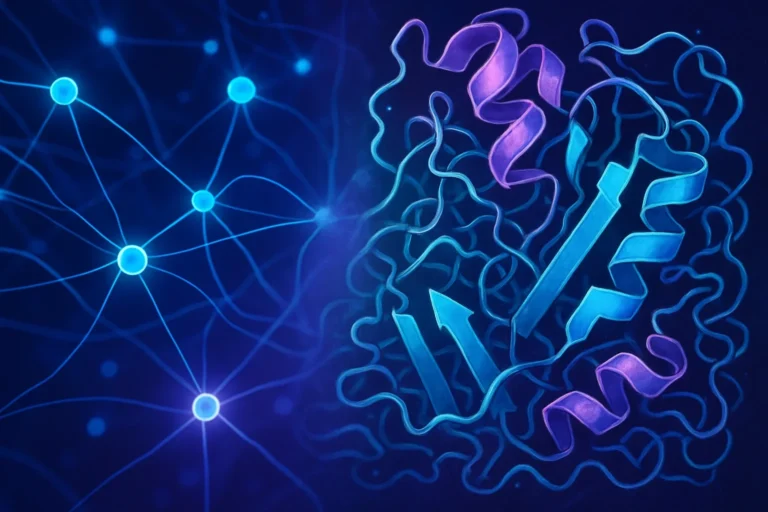
Released in June 2021, AlphaFold 2 leveraged advanced deep learning, using a vast database of known protein structures and evolutionary sequence data to predict a protein’s three‑dimensional shape from its linear amino‑acid sequence alone AlphaFold.
Central to AlphaFold’s success is the Evoformer module, an attention‑based architecture that iteratively refines pairwise residue relationships and coordinates, enabling the model to learn both local and long‑range interactions inherent in folded structures Nature paper.
Training AlphaFold involved millions of protein families from the Protein Data Bank (PDB) PDB, coupled with multiple sequence alignments (MSAs) that capture evolutionary constraints; the model learns to infer these constraints directly from sequence data.
On the CASP14 benchmark, AlphaFold achieved a median GDT‑TS score of 92.4%, surpassing all competing methods and reaching the threshold required for practical application in biology and medicine.
Scientific Impact: From Bench to Bedside
AlphaFold’s predictions have been rapidly adopted by the scientific community, with over 300,000 protein structures released to the public in March 2022, filling gaps in the PDB and providing a blueprint for experimental validation Science American.
In drug discovery, the accurate modeling of target proteins enables virtual screening of ligands, drastically reducing the need for costly crystallography or cryo‑EM experiments Nature Methods.
For example, researchers used AlphaFold to propose a high‑affinity binder for the SARS‑CoV‑2 spike protein, expediting the development of neutralizing antibodies as detailed in a 2021 study Cell Research.
Beyond therapeutics, AlphaFold informs fundamental questions about protein evolution, stability, and folding pathways, allowing biochemists to test hypotheses on the fly and design novel enzymes with industrial applications Nature Biotechnology.
Why Deep Learning Outperforms Traditional Methods
Traditional ab initio folding methods relied on physics‑based simulations that are computationally intensive and limited to small proteins, whereas AlphaFold harnesses pattern recognition across millions of examples to extrapolate folding rules Rev. Mod. Phys..
The network’s capacity to encode the statistical co‑occurrence of amino acids across evolution confers an inherent knowledge of residue interactions that classical algorithms lack.
Additionally, AlphaFold’s end‑to‑end differentiable framework allows rapid inference—predicting a protein of 300 residues in seconds—whereas molecular dynamics may take days or weeks Nature Methods.
These advantages have positioned AlphaFold as the de‑facto standard for structural biology, with many academic labs and pharmaceutical companies integrating it into their pipelines Reuters.
Future Directions and Ethical Considerations
While AlphaFold has solved an eighty‑year challenge, open questions remain, such as accurately modeling multi‑protein complexes, intrinsically disordered regions, and post‑translational modifications Nature Structural & Molecular Biology.
Researchers are also exploring generative models that can design entirely new proteins, potentially yielding therapeutics for previously undruggable targets or enzymes for sustainable biomanufacturing Patterns.
Ethically, the democratization of structural knowledge raises concerns about dual‑use research; safeguards such as responsible data sharing and oversight by scientific societies are essential to prevent misuse AAAI.
Conclusion and Call to Action
Embrace the power of AI in biology—whether you are a researcher, a biotech entrepreneur, or a science enthusiast, staying informed about AI solves protein folding via AlphaFold and its successors is crucial for the next wave of innovation.

100+ Science Experiments for Kids
Activities to Learn Physics, Chemistry and Biology at Home
Buy now on Amazon
Advanced AI for Kids
Learn Artificial Intelligence, Machine Learning, Robotics, and Future Technology in a Simple Way...Explore Science with Fun Activities.
Buy Now on Amazon
Easy Math for Kids
Fun and Simple Ways to Learn Numbers, Addition, Subtraction, Multiplication and Division for Ages 6-10 years.
Buy Now on Amazon