A Fun Experiment to Understand Capillary Action
Have you ever noticed how plants pull water from the soil or how a paper towel quickly absorbs a spill? These everyday moments are powered by a fascinating scientific process called capillary action. It allows liquids to move through tiny spaces without any external force. With a simple experiment using colored water and paper towels, you can see this invisible science in action right before your eyes.
This easy activity is perfect for classrooms, home learning, or anyone curious about how liquids behave in nature.
What Is Capillary Action?
Capillary action is the ability of a liquid to travel through narrow spaces, even against gravity. It happens because of two natural forces working together:
- Adhesion: Water molecules stick to other surfaces, such as paper fibers
- Cohesion: Water molecules stick to each other
When these forces combine, water is pulled upward through small gaps, like the tiny fibers inside a paper towel.
Materials Needed for the Experiment
You only need a few simple supplies:
- Clear glass or cup
- Water
- Food coloring (one or more colors)
- White paper towels
- Scissors
- Timer or clock
- Flat surface
Clear materials make it easier to observe the movement of water.
Step-by-Step: Capillary Action Experiment
- Prepare the colored water
Fill a glass with water and add a few drops of food coloring. Stir until the color is evenly mixed. - Cut the paper towels
Cut paper towels into long strips. They should be narrow enough to dip into the glass easily. - Set up the test
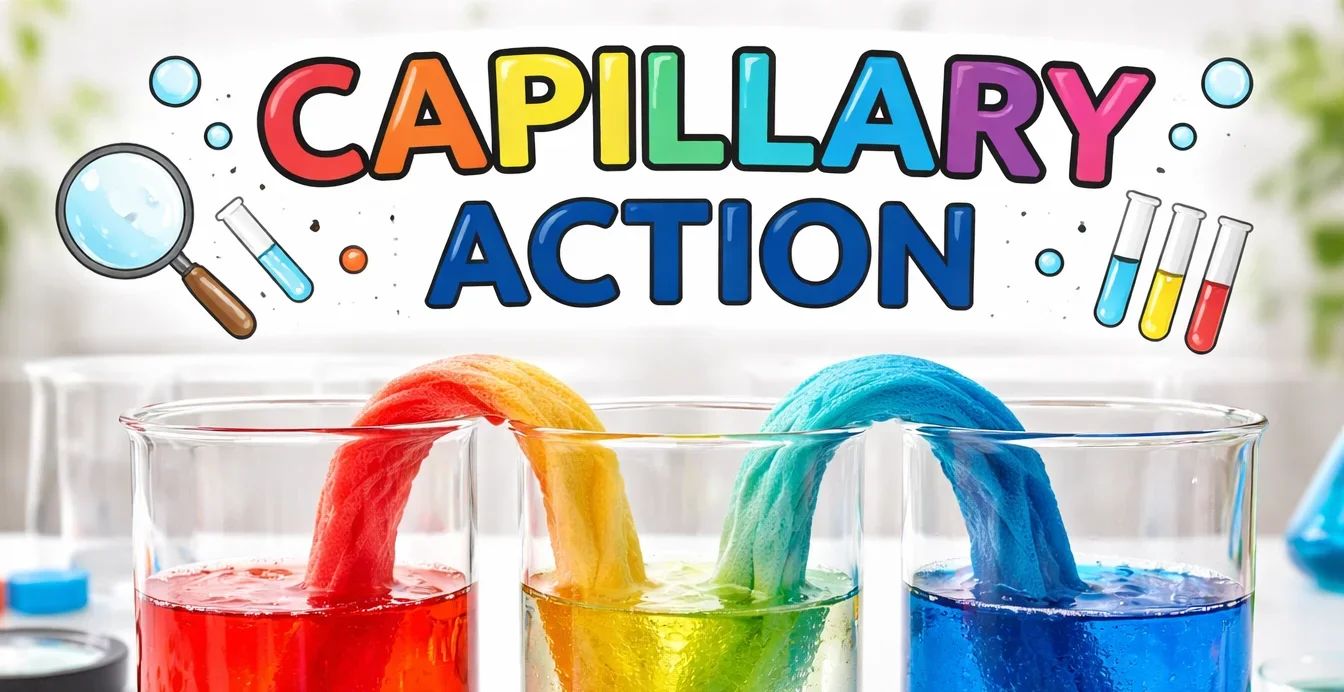
Place one end of a paper towel strip into the colored water while the other end hangs outside the glass. - Start observing
Watch closely as the water begins to climb up the paper towel. Start a timer and note how quickly it moves. - Track the progress
Observe how high the water rises over time. You can repeat the experiment with different colors or towel widths.
What You’ll See Happen
Within minutes, the colored water will slowly travel upward through the paper towel. The fibers act like tiny tubes that pull the water along. As the liquid climbs, the color spreads, making the process easy to see and understand.
Why This Experiment Works
Paper towels are made of countless microscopic channels. These narrow spaces enhance capillary action, allowing water to move upward efficiently. The thinner the space, the stronger the capillary effect. Eventually, gravity balances out the movement, and the water stops rising.
The Science Behind the Movement
Several scientific factors play a role:
- Surface tension: Helps water maintain structure as it climbs
- Adhesion: Pulls water along paper fibers
- Cohesion: Keeps water molecules connected
- Gravity: Limits how high the water can rise
Together, these forces create the upward movement you observe.
Everyday Uses of Capillary Action
Capillary action plays an important role in many areas of life:
- Plant growth: Moves water from roots to leaves
- Absorbent products: Used in paper towels, tissues, and sponges
- Medical testing: Helps liquids travel through test strips
- Construction: Affects how moisture moves through building materials
This simple experiment reflects processes used in nature and industry every day.
Ways to Make It More Interesting
- Use multiple colors to create a rainbow effect
- Compare different materials like cloth or tissue
- Measure how fast water travels and record results
- Try changing the angle of the paper towel
These variations encourage critical thinking and deeper understanding.
Final Thoughts
Capillary action may seem invisible, but this experiment makes it easy to see and understand. With just colored water and paper towels, you can explore a powerful natural process that affects plants, materials, and technology around us.
It’s simple, engaging, and a great reminder that science is everywhere—even in everyday household items. Try it out and let curiosity lead the way!

100+ Science Experiments for Kids
Activities to Learn Physics, Chemistry and Biology at Home
Buy now on Amazon
Advanced AI for Kids
Learn Artificial Intelligence, Machine Learning, Robotics, and Future Technology in a Simple Way...Explore Science with Fun Activities.
Buy Now on Amazon
Easy Math for Kids
Fun and Simple Ways to Learn Numbers, Addition, Subtraction, Multiplication and Division for Ages 6-10 years.
Buy Now on Amazon