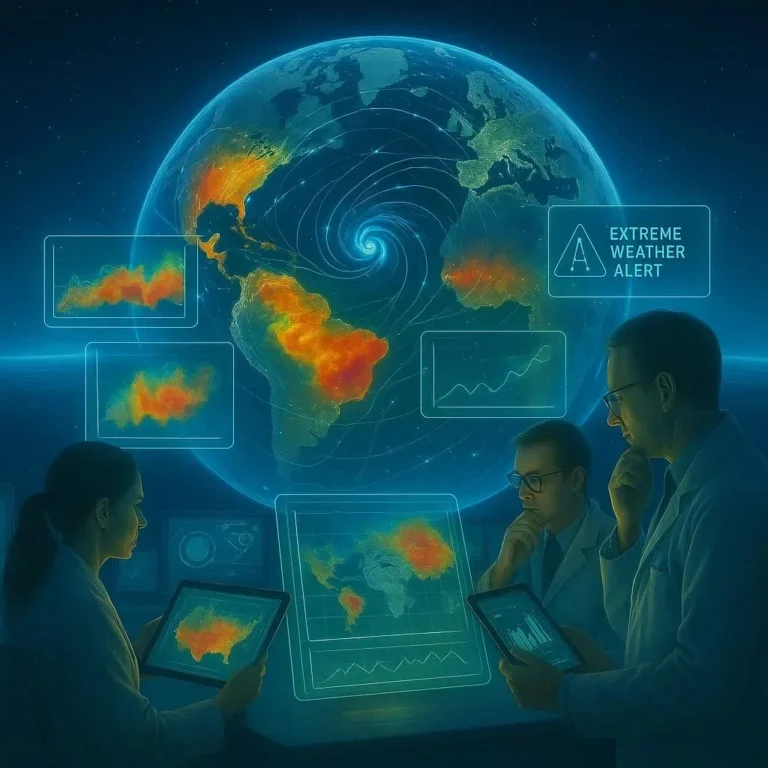
Technosignatures AI Exploration Advances
Technosignatures are indicators that point to advanced technological activity beyond Earth. In the modern era, the field is rapidly expanding with new telescopes and space probes pushing the boundaries of observation. AI technologies—especially machine learning and deep learning—are now essential in handling the colossal data sets required for these searches. By automating pattern recognition and anomaly detection, scientists can sift through signals that would otherwise remain hidden.
What Are Technosignatures?
Technosignatures refer to observable footprints left by technologically capable civilizations. These can range from radio emissions and laser pulses to engineered megastructures that alter a star’s light curve. The concept broadens the scope of the traditional SETI effort by incorporating diverse electromagnetic, chemical, and even gravitational signatures. Defining technosignatures clarifies the types of data astronomers must collect and analyze with precision.
While early SETI focused on narrowband radio signals, the modern field embraces a spectrum of potential signals across multiple wavelengths. Observatories now track infrared excesses, spectral lines of industrial pollutants, and patterns in stellar variability that could hint at orbiting megastructures. Each of these candidates offers a window into extraterrestrial engineering abilities. Cataloging them demands extensive, coordinated data collection worldwide.
Critics argue that many proposed technosignatures could arise from natural astrophysical processes. For example, periodic dimming of starlight can be caused by orbiting planets rather than colossal habitat rings. Consequently, rigorous statistical tests and validation pipelines are essential before asserting extraterrestrial origins. These protocols rely on cross‑checking observations across separate telescopes and time frames.
Beyond detection, technosignature research explores the implications of confirming extraterrestrial technology. It raises questions about frequency, distribution, and the longevity of intelligent life. It also informs the design of future missions that might communicate or observe with outside civilizations. As such, technosignatures lie at the heart of humanity’s quest to understand its place in the cosmos.
AI Methodologies for Detecting Technosignatures
Machine learning models can sift through billions of data points faster than any human team. Supervised learning algorithms are trained on labeled datasets containing known natural and artificial signals. These models learn the distinguishing patterns that separate genuine technosignatures from stellar noise.
Unsupervised learning, on the other hand, identifies anomalies without prior labeling. Clustering techniques group similar data points, flagging outliers that may represent new or unexpected technosignatures. Autoencoders reduce dimensionality and reconstruct signals, where reconstruction errors highlight atypical events. These methods complement each other across different data domains.
Reinforcement learning has also begun to play a role, especially in optimizing observation strategies. By rewarding missions that acquire high‑value data, these algorithms can suggest optimal pointing sequences for telescopes. This reduces wasted time pointing at uninformative regions of the sky, thereby accelerating the search for technosignatures.
Natural language processing is emerging as a tool for sifting through the growing body of textual reports from radio observatories, identifying potential human‑made communication attempts. By extracting key phrases and timing patterns, these systems help flag suspicious transmissions for further scrutiny. Integrating all these AI approaches creates a robust, adaptive pipeline for technosignature detection.
Case Studies in Technosignature Hunting
The Breakthrough Listen project exemplifies a successful use of AI for technosignature hunting. Leveraging the Parkes and Green Bank radio telescopes, researchers processed terabytes of data with deep learning classifiers. The project’s early findings included repeated narrowband signals that, after rigorous analysis, were deemed natural yet showcased the power of automated screening. These lessons now guide newer surveys across multiple wavelengths.
Another notable case is the search for Dyson‑like megastructures using data from the Kepler and TESS missions. AI algorithms flagged stars with unusual light‑curve signatures, prompting follow‑up observations. In one instance, the peculiar dimming of KIC 8462852 stimulated extensive spectroscopic campaigns. While the mystery persists, the process demonstrates how AI can spot potential technosignatures in vast photometric datasets.
The Allen Telescope Array’s real‑time radio signal monitoring program also highlights AI’s role. Using convolutional neural networks, the system distinguishes coherent pulses from cosmic background radiation. By filtering out terrestrial interference, the program increases the sensitivity for detecting faint, narrowband emissions that could indicate extraterrestrial technology.
Deep‑space probes such as the Voyager missions provide indirect technosignature data in the form of interstellar dust measurements. AI models analyze particulate composition, searching for signatures that could derive from industrial by‑products. Although the data remain ambiguous, the endeavor underscores the expanding scope of technosignature research beyond radio frequencies.
Challenges Facing Technosignature Searches
One primary challenge lies in distinguishing artificial signals from the cosmos’s myriad natural phenomena. Noise, interference, and signal degradation complicate interpretation, especially at faint signal levels. Comprehensive calibration pipelines and cross‑validation across observatories are essential to guard against false positives.
Data volume presents another hurdle. As telescopes become more powerful, the amount of raw data grows exponentially. Storing, processing, and indexing terabites of information require scalable infrastructure and efficient compression techniques. AI algorithms help by prioritizing the most promising data for deeper analysis.
Bias in machine learning models can skew detection rates. If training data overrepresent certain signal types, the system may become insensitive to novel technosignatures. Incorporating diverse, simulated datasets and continually updating models mitigates this risk. Transparent model architecture also builds confidence in the results.
Finally, international collaboration is limited by differing data-sharing policies. Many observatories keep proprietary data for extended periods, hindering global search efforts. Harmonizing licensing agreements and adopting open‑data frameworks would accelerate AI‑driven technosignature detection worldwide.
Future Prospects for Technosignature Exploration
Upcoming flagship missions like the James Webb Space Telescope and the Extremely Large Telescope will deliver unprecedented resolution and sensitivity. AI will be instrumental in extracting technosignatures from the high‑dimensional data these telescopes will generate, especially in infrared and optical regimes.
Quantum computing holds the promise of solving complex signal‑processing problems far faster than classical computers. As qubit coherence improves, algorithms can analyze large parameter spaces, searching for subtle signatures that elude traditional methods. This leap could shorten the timescale from data collection to discovery dramatically.
Citizen science initiatives could harness human pattern‑recognition skills, augmented by AI pre‑filtering. Volunteers could verify anomalous patterns flagged by neural networks, reducing algorithmic false positives. This hybrid model not only increases throughput but also public engagement in the search for extraterrestrial intelligence.
In tandem with technological advances, interdisciplinary research will refine the criteria for what constitutes a credible technosignature. Philosophers, anthropologists, and engineers will collaborate to model plausible extraterrestrial technologies, guiding observational priorities. Such cross‑field synergy ensures that AI‑driven searches remain grounded in realistic expectations.
Thus, as computational power escalates and our observational reach expands, AI-driven technosignature hunting stands poised to transform our understanding of life beyond Earth. By efficiently sifting through the cosmic noise, these systems bring the extraordinary possibility of detecting extraterrestrial technology within reach of human ingenuity. Continued innovation in AI and hardware will only accelerate this exciting frontier, inviting a new era of discovery and wonder.
Technosignatures AI Exploration Advances promises a data‑rich, rapid pathway to uncovering extraterrestrial signals. Embrace the cutting‑edge tools now shaping the search for intelligent life beyond our planet. Join the mission: support AI research, advocate open data, and stay tuned for life‑changing insights that AI may soon reveal.
Frequently Asked Questions
Q1. What exactly are technosignatures?
Technosignatures are observable artifacts left by advanced technological civilizations, such as radio broadcasts, laser pulses, or engineered megastructures that alter a star’s light curve. They differ from biosignatures, which indicate biological activity, by focusing on artificial rather than natural sources. Researchers catalog potential technosignatures to guide observational strategies.
Q2. How does AI improve technosignature detection?
AI automates the analysis of massive data streams, recognizing patterns and anomalies that human detectors might miss. Machine learning models are trained on known natural and artificial signals, allowing them to discriminate new signals with higher accuracy. This speeds up the discovery process and increases sensitivity to weak signals.
Q3. Can we trust AI-generated technosignature findings?
Trust comes from rigorous validation: AI-identified signals are cross‑checked across multiple instruments and independent algorithms. Peer review and transparent model documentation further ensure reliability. While AI reduces human bias, final interpretation still involves expert astronomers.
Q4. What are the biggest challenges in searching for technosignatures?
Separating artificial signals from cosmic noise, managing vast datasets, and avoiding bias in AI models are major hurdles. Additionally, limited data sharing across observatories hampers collaborative searches. Addressing these challenges requires improved infrastructure, open data policies, and continuous model refinement.
Q5. How can the public get involved?
Citizen science projects enable amateurs to help classify potential technosignatures, boosting data analysis capacity. Enthusiasts can support research funding, advocate for open data, and participate in public outreach events. Directly engaging with scientists through conferences or online forums also enriches the global effort.
Related Articles
Explore more on the search for extraterrestrial intelligence:
- Machine Learning in Radio Astronomy
- Prospects of Dyson Satellites
- Quantum Computing for Big Data Analysis

100+ Science Experiments for Kids
Activities to Learn Physics, Chemistry and Biology at Home
Buy now on Amazon
Advanced AI for Kids
Learn Artificial Intelligence, Machine Learning, Robotics, and Future Technology in a Simple Way...Explore Science with Fun Activities.
Buy Now on Amazon
Easy Math for Kids
Fun and Simple Ways to Learn Numbers, Addition, Subtraction, Multiplication and Division for Ages 6-10 years.
Buy Now on Amazon