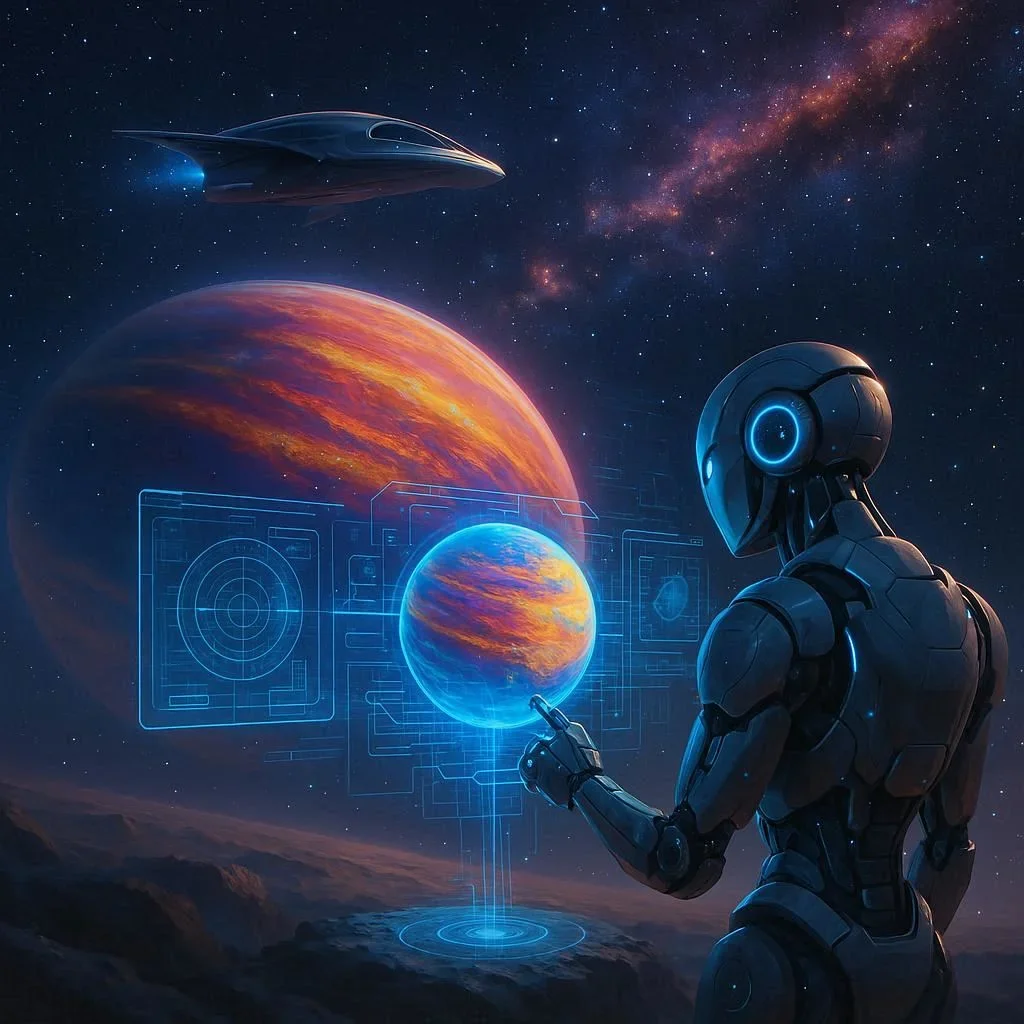
AI Animates Star Birth
Artificial intelligence has moved beyond data crunching and into the realm of visual storytelling, breathing life into the cosmic processes that shape our universe. By harnessing machine learning algorithms, researchers can now animate the birth of stars with unprecedented realism, turning static equations into dynamic, immersive experiences. This fusion of AI and astrophysics not only deepens scientific insight but also invites the public to witness the stellar nursery in vivid detail. In this article, we explore how AI animates the birth of stars, the techniques behind the scenes, and the broader implications for science communication.
How AI Models Simulate Nebulae
At the heart of star formation lies the turbulent dance of gas and dust within giant molecular clouds. Traditional simulations rely on solving complex hydrodynamic equations, a process that can take weeks on supercomputers. AI accelerates this by learning patterns from existing simulations and generating new, high‑resolution models in seconds. Researchers train neural networks on datasets from the Star Formation literature, enabling the AI to predict how density waves propagate and collapse into protostars. The result is a fluid, time‑evolving animation that captures the chaotic beauty of a nebula turning into a shining star.
AI Visualizes Stellar Collapse
Once a dense core forms, gravity pulls the material inward, heating it to millions of degrees. Capturing this rapid collapse requires fine temporal resolution, which is computationally expensive. AI models, particularly generative adversarial networks (GANs), interpolate between key simulation snapshots, creating smooth transitions that preserve physical accuracy. By integrating data from the Hubble Space Telescope and the James Webb Space Telescope, the AI refines its predictions, ensuring that the animated collapse reflects real observations. This approach allows scientists to test hypotheses about magnetic fields and turbulence in ways that were previously impossible.
From Data to AI-Driven Scenes
Transforming raw simulation data into a polished animation involves several stages: data preprocessing, model inference, and post‑processing. The AI first normalizes density, temperature, and velocity fields, then feeds them into a convolutional neural network that outputs a volumetric representation of the star‑forming region. A second network translates this volume into a visual format, applying realistic lighting and color mapping. The final step uses a rendering engine to produce frame‑by‑frame imagery that can be compiled into a video or interactive web experience.
Below is a concise table summarizing the key parameters used in a typical AI‑driven star birth animation:
| Parameter | Typical Value | Source |
|---|---|---|
| Cloud Mass | 10,000 M☉ | ArXiv Study |
| Resolution | 512³ voxels | Simulation Data |
| Time Step | 0.01 Myr | Hydrodynamic Models |
| Neural Network Layers | 12 convolutional layers | Research Paper |
These parameters ensure that the animation remains faithful to the underlying physics while remaining computationally tractable.
AI Enhances Public Engagement
Beyond research, AI‑animated star birth videos serve as powerful educational tools. By presenting complex processes in an accessible visual format, they help demystify topics like stellar evolution and cosmic birth. Interactive platforms, such as the Space.com science gallery, allow users to explore different stages of star formation, adjusting parameters to see how changes affect the outcome. This hands‑on experience fosters curiosity and encourages deeper learning.
Educators can incorporate these animations into curricula, using them to illustrate concepts that are otherwise abstract. For instance, a high‑school physics teacher might pair an AI animation with a lab exercise on gravitational collapse, giving students a concrete visual reference. The result is a richer, more engaging learning environment that bridges the gap between theory and observation.
Future Horizons for AI in Astronomy
As AI models grow more sophisticated, their applications in astronomy will expand. Future projects aim to simulate entire galaxies, capturing the interplay between star formation, supernova feedback, and dark matter dynamics. Additionally, AI could help interpret data from upcoming missions like the Large Synoptic Survey Telescope, rapidly identifying transient events and predicting their evolution.
Another promising avenue is the integration of AI with virtual reality (VR). By rendering AI‑generated star birth scenes in immersive VR, scientists can provide users with a 360° view of a protostellar core, offering an unprecedented sense of scale and depth. Such experiences could revolutionize public outreach, making the cosmos feel more immediate and personal.
Conclusion: AI has unlocked a new frontier in visualizing the birth of stars, turning complex equations into captivating animations that serve both science and society. By harnessing machine learning, researchers can now simulate stellar nurseries with speed and fidelity that were once unimaginable. These AI‑driven visuals not only advance our understanding of stellar evolution but also inspire the next generation of astronomers and enthusiasts. If you’re passionate about the cosmos and eager to explore the cutting edge of AI in astronomy, dive deeper into our resources and join the conversation today.
Frequently Asked Questions
Q1. How does AI improve star formation simulations?
AI accelerates simulations by learning from existing data, allowing it to predict complex fluid dynamics in seconds rather than weeks. This speeds up research cycles and enables real‑time visualizations.
Q2. Are AI animations scientifically accurate?
Yes, AI models are trained on high‑fidelity simulation data and validated against observational evidence from telescopes like Hubble and James Webb. They preserve key physical properties while enhancing visual clarity.
Q3. Can I use AI star birth animations in my classroom?
Absolutely. Many educational platforms provide downloadable animations that can be integrated into lesson plans, helping students grasp complex astrophysical concepts.
Q4. What hardware is needed to run these AI models?
While training large models requires GPUs, inference (generating animations) can run on standard CPUs or modest GPUs, making it accessible to most research labs and educators.
Q5. Where can I learn more about AI in astronomy?
Explore academic journals, university research groups, and open‑source projects on platforms like GitHub. Many institutions publish tutorials and datasets for public use.
Related Articles

100+ Science Experiments for Kids
Activities to Learn Physics, Chemistry and Biology at Home
Buy now on Amazon
Advanced AI for Kids
Learn Artificial Intelligence, Machine Learning, Robotics, and Future Technology in a Simple Way...Explore Science with Fun Activities.
Buy Now on Amazon
Easy Math for Kids
Fun and Simple Ways to Learn Numbers, Addition, Subtraction, Multiplication and Division for Ages 6-10 years.
Buy Now on Amazon