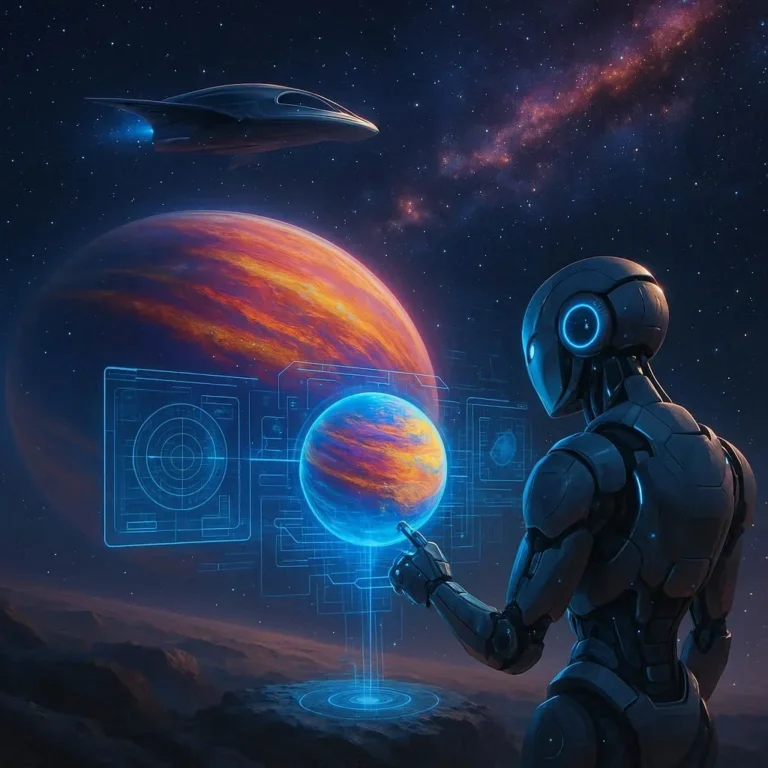
Warp Drive Is It Possible
Warp drive, the concept of propelling a spacecraft faster than light by warping space‑time, has long captured the imagination of scientists and science‑fiction fans alike. The idea promises interstellar journeys that would otherwise take millennia, turning the cosmos from a distant dream into an accessible frontier. Yet, the question remains: is warp drive truly possible, or is it a speculative fantasy bound by the laws of physics? In this article, we examine the scientific foundations, energy challenges, and current research that shape the feasibility of warp drive.
Historical Roots of Warp Drive
The notion of faster‑than‑light travel predates modern physics. Early 20th‑century physicists like Albert Einstein and Nathan Rosen explored the concept of wormholes—shortcuts through space‑time that could, in theory, allow instantaneous travel between two points. However, it was not until 1994 that physicist Miguel Alcubierre formalized the idea of a warp bubble in his paper on the Alcubierre drive. Alcubierre’s metric demonstrated that a spacecraft could be carried by a bubble of contracted space ahead of it and expanded space behind, effectively moving the ship faster than light relative to distant observers while locally obeying relativity.
The Alcubierre Metric Explained
At its core, the Alcubierre metric relies on manipulating the curvature of space‑time. By contracting space in front of a vessel and expanding it behind, the ship sits in a region of flat space that moves through a distorted background. This approach sidesteps the conventional speed limit because the ship itself never accelerates locally; instead, the surrounding space moves. The mathematics of the metric involve a function that defines the bubble’s shape and velocity, and the resulting Einstein field equations reveal the energy conditions required to sustain such a bubble.
Energy and Practical Constraints
One of the most daunting obstacles to warp drive is the enormous energy requirement. Early estimates suggested that a warp bubble would need mass-energy equivalent to the entire observable universe. Subsequent refinements have reduced the figure, but it still remains orders of magnitude beyond our current capabilities. The energy density required is negative, a property not found in ordinary matter. Theoretical constructs like exotic matter or quantum vacuum fluctuations are proposed as sources of negative energy density, but no experimental evidence confirms their existence in the necessary quantities.
Below is a simplified list of the primary energy challenges:
- Magnitude of required energy: trillions of times the Sun’s output.
- Negative energy density: no known material exhibits this property at macroscopic scales.
- Stability of the warp bubble: small perturbations could collapse the bubble or cause catastrophic spacetime distortions.
- Control mechanisms: precise manipulation of space‑time curvature demands technology far beyond current engineering.
These constraints are compounded by the fact that the Alcubierre metric, while mathematically consistent, does not account for quantum effects that could destabilize the bubble. Recent studies published in ScienceDirect and Nature highlight the need for a quantum gravity framework to fully assess warp drive viability.
Current Research and Experimental Approaches
Despite the daunting hurdles, research continues. NASA’s NASA has funded theoretical studies on warp drive and related concepts such as the Alcubierre metric and quantum vacuum engineering. Meanwhile, the Massachusetts Institute of Technology (MIT) hosts interdisciplinary teams exploring the feasibility of negative energy generation through Casimir effect experiments and advanced metamaterials.
Experimental efforts focus on two main fronts:
- Quantum vacuum manipulation: Researchers are investigating whether engineered boundary conditions can produce measurable negative energy densities, a prerequisite for a stable warp bubble.
- Space‑time curvature simulation: Using high‑precision laser interferometry, scientists aim to simulate minute distortions in space‑time, providing insights into how a warp bubble might behave under realistic conditions.
While these experiments are in their infancy, they represent critical steps toward understanding whether the exotic physics required for warp drive can be realized in practice.
Future Outlook and Theoretical Possibilities
Looking ahead, several theoretical pathways could potentially lower the energy barrier:
- Revising the warp bubble geometry to reduce energy density.
- Discovering new forms of exotic matter or harnessing quantum entanglement to generate negative energy.
- Integrating quantum gravity theories, such as loop quantum gravity or string theory, to reconcile general relativity with quantum mechanics in the context of warp drive.
Even if warp drive remains out of reach for the foreseeable future, the pursuit of this technology drives innovation in related fields—quantum computing, high‑energy physics, and materials science—yielding benefits that extend far beyond interstellar travel.
Conclusion: The Warp Drive Frontier
In summary, warp drive remains a tantalizing theoretical construct that challenges our understanding of physics. While the Alcubierre metric offers a mathematically consistent framework, the practical obstacles—particularly the staggering energy requirements and the elusive negative energy density—render it currently impractical. Nonetheless, ongoing research at institutions like NASA and MIT keeps the possibility alive, pushing the boundaries of science and engineering.
Ready to explore the next frontier of space travel? Subscribe to our newsletter for the latest updates on warp drive research, quantum physics breakthroughs, and more exciting discoveries that could one day make interstellar journeys a reality.
Frequently Asked Questions
Q1. What is a warp drive?
A warp drive is a theoretical propulsion system that would allow a spacecraft to travel faster than light by warping space‑time. It works by contracting space in front of the vessel and expanding it behind, creating a bubble that moves the ship. The ship itself remains in a locally flat region, so it never exceeds the speed of light locally. The concept was popularized by science fiction but has a basis in Einstein’s general relativity. It remains purely speculative until experimental evidence is found.
Q2. How does the Alcubierre metric work?
The Alcubierre metric is a solution to Einstein’s field equations that describes a warp bubble. It defines a spacetime geometry where a region of flat space is carried along by a distortion of the surrounding metric. The bubble’s front contracts space, while the rear expands it, effectively moving the bubble faster than light relative to distant observers. The ship inside experiences no acceleration, avoiding relativistic time dilation. However, the metric requires exotic matter with negative energy density to sustain the bubble.
Q3. What are the main energy challenges?
The biggest hurdle is the enormous energy requirement, originally estimated to be comparable to the mass-energy of the observable universe. Even with optimizations, the needed energy remains many orders of magnitude beyond current technology. Additionally, the energy density must be negative, a property not found in ordinary matter. Generating sufficient negative energy would likely involve quantum vacuum effects like the Casimir effect. Finally, maintaining a stable bubble would demand precise control over spacetime curvature.
Q4. Is negative energy density possible?
Negative energy density has been observed in small amounts in laboratory settings, such as the Casimir effect between closely spaced plates. However, the magnitude is minuscule compared to what a warp bubble would require. Theoretical proposals suggest quantum field fluctuations or exotic matter could provide larger negative energies, but no experimental evidence supports this at macroscopic scales. Some quantum gravity models predict negative energy densities under specific conditions, but these remain speculative. Thus, while not impossible in principle, practical generation of the required negative energy is currently beyond reach.
Q5. What current research is being done?
NASA has funded theoretical studies on warp drive and related concepts, exploring the feasibility of the Alcubierre metric. MIT researchers are experimenting with Casimir effect setups to measure negative energy densities and investigating metamaterials that could mimic spacetime curvature. Quantum vacuum engineering projects aim to create controlled boundary conditions that might produce usable negative energy. High‑precision laser interferometry experiments are attempting to simulate tiny spacetime distortions to understand bubble dynamics. These efforts are early but provide critical data for assessing warp drive viability.
Related Articles

100+ Science Experiments for Kids
Activities to Learn Physics, Chemistry and Biology at Home
Buy now on Amazon
Advanced AI for Kids
Learn Artificial Intelligence, Machine Learning, Robotics, and Future Technology in a Simple Way...Explore Science with Fun Activities.
Buy Now on Amazon
Easy Math for Kids
Fun and Simple Ways to Learn Numbers, Addition, Subtraction, Multiplication and Division for Ages 6-10 years.
Buy Now on Amazon