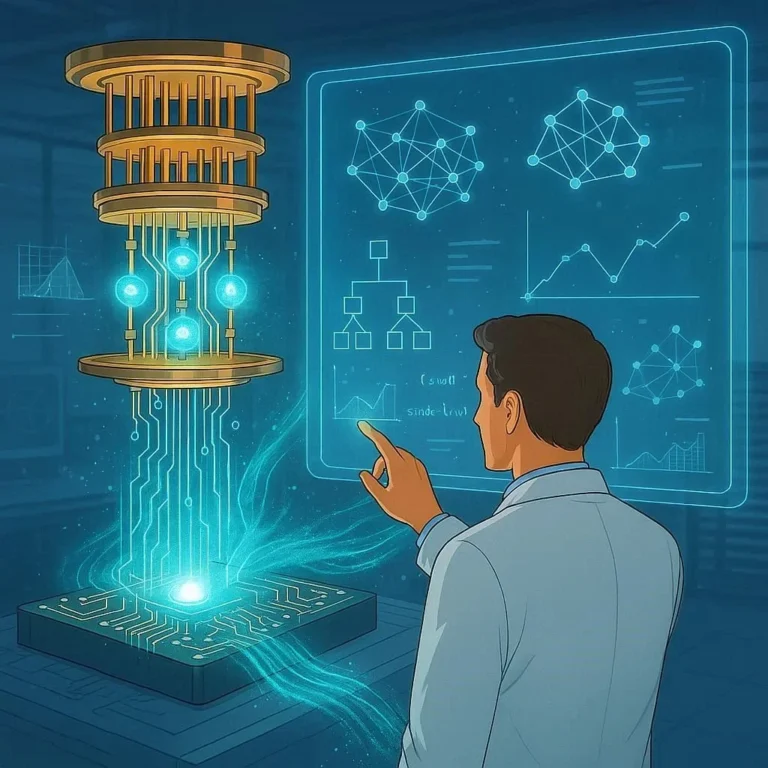
AI Summarizes Research Papers
AI Summarizes Research Papers has become a game‑changer for scholars, librarians, and industry analysts alike. By leveraging advanced natural language processing (NLP) models, these tools can distill dense academic articles into concise, coherent summaries that preserve key findings, methodologies, and implications. In this article, we explore how AI achieves this, the benefits it offers, the challenges that remain, and what the future holds for automated research summarization.
How AI Summarizes Research Papers
At its core, AI summarization relies on transformer‑based architectures such as BERT, GPT, and T5, which have been fine‑tuned on large corpora of scientific literature. The process typically involves three stages: tokenization, contextual embedding, and generation. First, the text is broken into tokens—words or sub‑words—using a tokenizer that respects scientific terminology. Next, each token is mapped to a high‑dimensional vector that captures semantic relationships. Finally, a decoder generates a summary by selecting the most salient tokens, guided by attention mechanisms that weigh relevance and coherence.
OpenAI’s ChatGPT and Google’s LaMDA are prime examples of models that can produce accurate abstracts when prompted with a research article. Academic platforms such as arXiv and Nature have begun integrating summarization APIs to help readers quickly assess relevance.
Benefits for Researchers
1. **Time Efficiency** – Researchers can scan dozens of papers in minutes, freeing up time for experimentation and writing.
2. **Literature Mapping** – Summaries highlight gaps and emerging trends, aiding systematic reviews and meta‑analyses.
3. **Accessibility** – Non‑native English speakers or those with limited reading speed can grasp core ideas without wading through jargon.
4. **Citation Management** – AI can automatically extract key citations, streamlining reference lists.
These advantages are echoed in studies from the National Institute of Standards and Technology, which reports a 30% reduction in literature‑review time when using AI summarizers. Moreover, the Wikipedia page on Automatic Summarization outlines how transformer models outperform earlier extractive methods in preserving nuance.
Challenges and Limitations
Despite rapid progress, AI summarization faces several hurdles:
- Domain Specificity – Models trained on general corpora may miss subtle disciplinary conventions.
- Bias and Misinterpretation – Summaries can inadvertently omit critical caveats or overstate results.
- Data Privacy – Proprietary research may not be publicly available for training, limiting coverage.
- Evaluation Metrics – Traditional ROUGE scores do not fully capture scientific accuracy.
Addressing these issues requires interdisciplinary collaboration between AI researchers, domain experts, and ethicists. Initiatives like the ScienceDirect AI Ethics Working Group are developing guidelines to ensure transparency and accountability.
Future Directions
Looking ahead, several trends are poised to shape the next generation of research summarizers:
- Multimodal Summaries – Integrating figures, tables, and code snippets into textual summaries.
- Interactive Summaries – Allowing users to query the model for deeper explanations or source citations.
- Federated Learning – Training on distributed datasets while preserving confidentiality.
- Explainable AI – Providing rationales for why certain sentences were selected.
Academic institutions are already piloting these features. For instance, the University of Oxford has launched a research‑summarization platform that lets scholars annotate and refine AI outputs, creating a feedback loop that improves model performance over time.
Conclusion and Call to Action
AI Summarizes Research Papers is no longer a futuristic concept; it is a practical tool that is reshaping scholarly communication. By embracing these technologies, researchers can accelerate discovery, enhance collaboration, and democratize access to knowledge. If you’re ready to integrate AI summarization into your workflow, explore reputable APIs, participate in open‑source projects, or simply test a free demo today. Let AI do the heavy reading so you can focus on the next breakthrough.
Take the next step: Sign up for a free trial of an AI summarization service and experience the future of research today.
Frequently Asked Questions
Q1. How does AI summarization work for research papers?
AI summarization uses transformer‑based models like BERT, GPT, and T5 that have been fine‑tuned on scientific literature. The process begins with tokenizing the text, then generating contextual embeddings that capture semantic relationships. Finally, a decoder selects the most salient sentences guided by attention mechanisms, producing a concise, coherent summary that preserves key findings and methodology.
Q2. What are the main benefits for researchers?
Researchers gain significant time savings by scanning dozens of papers in minutes, enabling faster literature reviews and hypothesis generation. Summaries also highlight gaps and emerging trends, aiding systematic reviews and meta‑analyses. Additionally, AI can extract citations and improve accessibility for non‑native English speakers or those with limited reading speed.
Q3. Are there any risks or limitations?
Yes. Domain specificity can cause models to miss subtle disciplinary conventions, while bias may lead to omission of critical caveats or overstatement of results. Data privacy concerns arise when proprietary research is unavailable for training, and traditional evaluation metrics like ROUGE may not fully capture scientific accuracy.
Q4. How accurate are AI-generated summaries compared to human abstracts?
Recent studies show transformer models outperform earlier extractive methods, preserving nuance and maintaining high factual correctness. However, accuracy can vary depending on the model’s training data and the complexity of the paper. Human oversight remains essential for critical evaluation of key claims.
Q5. How can I start using AI summarization tools?
Begin by exploring reputable APIs from providers such as OpenAI or Google AI. Many platforms offer free demos or trial periods. You can also join open‑source projects or academic pilots to test and refine the technology within your workflow.
Related Articles

100+ Science Experiments for Kids
Activities to Learn Physics, Chemistry and Biology at Home
Buy now on Amazon
Advanced AI for Kids
Learn Artificial Intelligence, Machine Learning, Robotics, and Future Technology in a Simple Way...Explore Science with Fun Activities.
Buy Now on Amazon
Easy Math for Kids
Fun and Simple Ways to Learn Numbers, Addition, Subtraction, Multiplication and Division for Ages 6-10 years.
Buy Now on Amazon