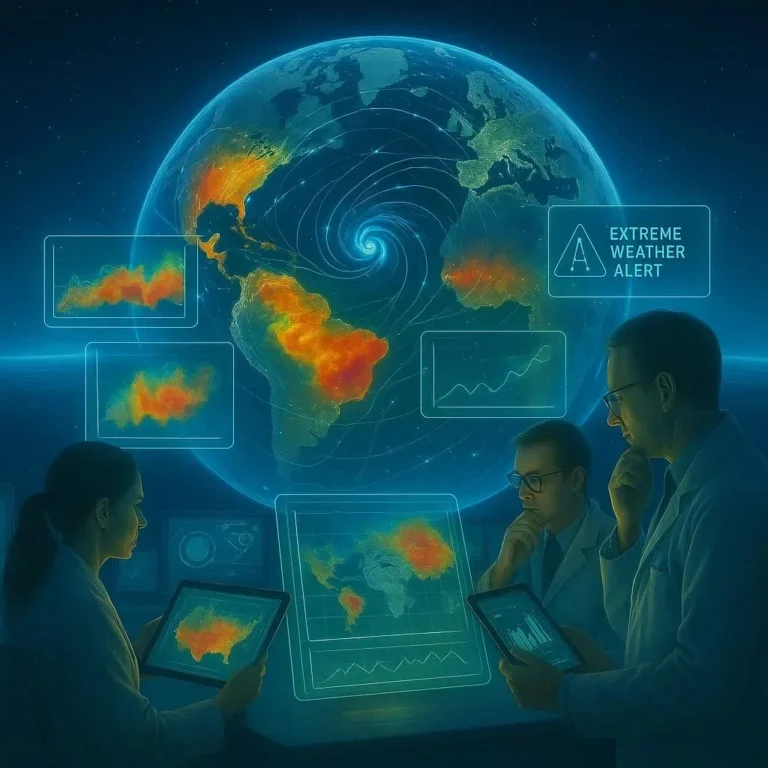

AI in Space-Based Climate Monitoring
Artificial intelligence (AI) is transforming how scientists monitor our planet from orbit. The fusion of AI with space-based climate monitoring provides unprecedented speed, accuracy, and depth in tracking environmental changes. As satellite constellations proliferate, algorithms capable of interpreting vast streams of imagery and sensor data are becoming indispensable. This article explores the key technologies, real-world applications, and future prospects of AI in space‑based climate monitoring, highlighting how these tools are reshaping evidence‑driven environmental stewardship.
AI in Space-Based Climate Monitoring: An Overview
Space‑based climate monitoring relies on remote sensing platforms that gather data on atmospheric composition, sea‑surface temperature, land‑cover, and cryospheric dynamics. Traditional analysis of this data involved manual classification or rule‑based software that could lag behind the volume of incoming signals. AI, particularly machine learning (ML) and deep learning, enables automated feature extraction and pattern recognition at scales impossible for human analysts.
The marriage of AI with satellite observation began with early classifiers that distinguished cloud types from infrared imagery. Modern systems now detect subtle variations in vegetation health using convolutional neural networks (CNNs) and predict extreme weather events through recurrent neural networks (RNNs).
Beyond improving detection, AI enhances data fusion by combining observations from multiple sensors—such as optical, radar, and lidar—to create higher‑resolution composite maps. This capability is crucial for understanding complex processes like hurricane evolution or glacier dynamics where single‑modal data fall short.
Applications of AI in Space‑Based Climate Monitoring
AI is already deployed across several critical environmental domains:
- Deforestation Detection – AI algorithms process Sentinel‑2 optical imagery to identify illegal logging in near real‑time, helping enforcement agencies act before large swaths of forest are lost.
- Soil Moisture Estimation – Combining radar data from Sentinel‑1 with AI models yields fine‑scale soil moisture maps, supporting drought forecasting and irrigation management.
- Sea‑Ice Extent Assessment – Deep learning clusters thousands of radar and infrared images to delineate sea‑ice edges, significantly improving the accuracy of climate projections.
- Atmospheric Gas Concentration Mapping – AI models trained on hyperspectral sensor data (e.g., PACE, TROPOZIS) retrieve concentrations of greenhouse gases like CO₂ and CH₄.
- Urban Heat Island Analysis – AI identifies micro‑climates in cities by analyzing thermal satellite data, informing urban planning and heat‑mitigation strategies.
By automating these tasks, AI mitigates the lag between data acquisition and actionable insight, a critical advantage as climate‑related events accelerate.
Data Fusion and AI: Merging Multiple Orbiting Sensors
One of the most challenging aspects of climate monitoring is integrating heterogeneous data streams. Satellites measure diverse variables—temperature, moisture, spectral reflectance, polarization—using sensors with different spatial, temporal, and spectral resolutions. AI excels in harmonizing these datasets.
For instance, a CNN can learn to align MODIS infrared imagery with Sentinel‑1 radar data, effectively translating between brightness temperatures and backscatter coefficients. This fused product improves land‑cover classification accuracy to over 90% in mixed‑vegetation zones. Another application merges thermal infrared from Landsat with optical data from Sentinel‑2, enabling precise mapping of wildfire burn scars and subsequent vegetation regrowth rates.
AI-driven data fusion also supports gap‑filling. When cloud cover obscures optical imagery, algorithms can infer missing values from radar or previous observations, maintaining continuous time series for climate indices such as the Normalized Difference Vegetation Index (NDVI).
By offering seamless integration, AI reduces the dependency on manual interpolation, which often introduces bias and uncertainty.
Challenges and Ethical Considerations in AI-Enabled Climate Observation
Despite its promise, deploying AI in environmental monitoring presents several technical and ethical challenges.
- Algorithmic Bias – Models trained on limited datasets may perform poorly in underrepresented regions, potentially skewing global climate assessments.
- Data Privacy – While satellite data is public, the aggregation of high‑resolution imagery can inadvertently reveal sensitive land‑use information.
- Model Interpretability – Deep networks can act as “black boxes,” making it hard to trace why certain predictions are made. This opacity hampers trust and regulatory compliance.
- Computational Cost – Training state‑of‑the‑art AI models requires substantial GPU resources, raising concerns about the environmental footprint of the AI itself.
Addressing these issues demands interdisciplinary collaboration among satellite operators, data scientists, ethicists, and policymakers. Initiatives such as the NASA Earth Data Program and the European Space Agency’s climate services are increasingly incorporating transparency frameworks and open‑source toolkits to promote reproducibility and fairness.
The Future of AI in Space‑Based Climate Monitoring
The trajectory of AI and space observation is moving toward faster, more autonomous systems. Laboratory‑scale testbeds are now integrating reinforcement learning agents that can autonomously schedule satellite overpasses to maximize data relevance for specific climate indicators.
In the near term, the launch of constellations like Planet Labs’ Dove and SpaceX’s Starlink will generate petabyte‑scale image streams, making real‑time AI inference essential. Researchers are exploring edge‑computing solutions, where AI models run onboard satellites, transmitting only the most relevant analytical results back to ground stations. This dramatically reduces bandwidth constraints, speeds up decision cycles, and retains situational awareness for rapid response.
Moreover, AI is set to play a pivotal role in validating climate model projections. By ingesting observationally derived temperature and precipitation datasets, machine‑learning emulators can bridge gaps between high‑resolution, localized data and coarse‑grid climate simulations.
Ultimately, widespread adoption of AI-informed climate monitoring could provide the robust evidence base needed to design mitigation strategies, track national commitments under Paris Agreement, and support adaptation efforts worldwide.
Conclusion and Call to Action
Artificial intelligence in space‑based climate monitoring is no longer a frontier; it is a cornerstone of contemporary environmental science. From automated deforestation alerts to real‑time drought prognoses, AI systems transform raw satellite observations into actionable insights that can save ecosystems, economies, and lives.
We encourage researchers to embrace open‑source AI frameworks, stakeholders to invest in data infrastructures, and policy makers to craft regulations that balance innovation with transparency.
Ready to harness AI for the planet? Contact our team to explore customized satellite‑AI solutions that keep you ahead of environmental change.
Frequently Asked Questions
Q1. What is AI in space-based climate monitoring?
AI in space-based climate monitoring refers to the use of machine learning and deep learning algorithms to process satellite imagery and sensor data. These models automate feature extraction, classify land cover, and predict atmospheric variables at unprecedented speed and precision. By converting raw observations into actionable insights, AI enhances our ability to monitor Earth’s changing climate in real time.
Q2. How does AI improve deforestation detection from satellites?
AI models trained on high-resolution optical imagery can detect subtle changes in forest canopy health within seconds of image acquisition. Convolutional neural networks identify illegal logging activity by distinguishing between natural variations and clear-cut patterns. This near real‑time detection allows authorities to respond swiftly, reducing the extent of irreversible forest loss.
Q3. What challenges are associated with AI models for climate data?
Key challenges include algorithmic bias, limited representation of remote regions, and the need for large, diverse training datasets. Model interpretability remains an issue, as deep neural networks often function as “black boxes.” Computational costs and the energy footprint of training large models also raise sustainability concerns.
Q4. How can AI be integrated into real-time satellite operations?
Edge‑computing approaches enable AI inference onboard satellites, transmitting only essential analytics to ground stations. Reinforcement learning agents can autonomously adjust satellite overpass schedules to capture the most relevant data for specific climate indicators. These innovations reduce bandwidth requirements and accelerate decision cycles during climate events.
Q5. What ethical considerations arise when using high‑resolution satellite AI?
High‑resolution imagery can inadvertently reveal sensitive land‑use information, raising data privacy concerns. AI models may perpetuate biases if trained on uneven datasets, potentially skewing global climate assessments. Transparent model documentation and open‑source toolkits are essential to promote fairness and accountability.
Related Articles

100+ Science Experiments for Kids
Activities to Learn Physics, Chemistry and Biology at Home
Buy now on Amazon
Advanced AI for Kids
Learn Artificial Intelligence, Machine Learning, Robotics, and Future Technology in a Simple Way...Explore Science with Fun Activities.
Buy Now on Amazon
Easy Math for Kids
Fun and Simple Ways to Learn Numbers, Addition, Subtraction, Multiplication and Division for Ages 6-10 years.
Buy Now on Amazon