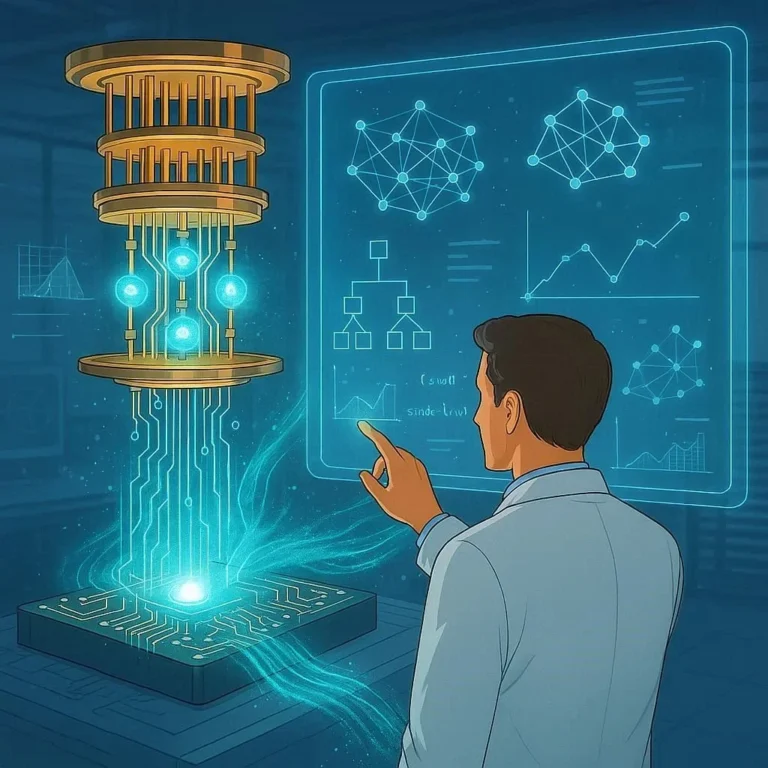
AI-Driven Satellite Swarm Coordination
In the rapidly evolving realm of space technology, AI-driven satellite swarm coordination has emerged as a transformative approach to orchestrating complex constellations. Instead of relying on a single powerful satellite, engineers now deploy fleets of smaller, cooperative spacecraft—each empowered by autonomous decision‑making—to achieve higher resolution Earth observation, resilient communications, and flexible mission profiles. In this post, we examine how artificial intelligence underpins the control of these swarms, its technical foundations, operational benefits, and the challenges that remain. By dissecting real-world examples and authoritative research, we illustrate why AI‑driven coordination is poised to become the backbone of next‑generation space infrastructure.
Foundational AI Techniques for Swarm Control
Underpinning any AI‑driven system is a suite of machine learning algorithms tailored to the unique constraints of space. Three core techniques are most prevalent:
- Reinforcement Learning (RL) – agents learn optimal flight paths and collision‑avoidance strategies through simulated trials, receiving rewards for maintaining safe separations and achieving mission objectives.
- Graph Neural Networks (GNNs) – they model inter‑satellite relationships, enabling efficient communication and collective behavior without a central coordinator.
- Federated Learning – satellites collaborate on training AI models locally, preserving data privacy and reducing ground‑based bandwidth requirements.
For instance, the NASA Goddard Space Flight Center has employed RL agents in the String of Pearls project to negotiate formation control among low‑Earth‑orbit cubesats.
Operational Architecture of Autonomous Swarms
Effective swarm deployment hinges on a robust architecture that blends hardware, software, and communication protocols. Key components include:
- Distributed Flight Control: Each node operates on a lightweight flight‑control computer capable of processing sensor data, executing AI decisions, and communicating with neighbors.
- Low‑Latency Inter‑Satellite Links: Optical or RF links enable near‑real‑time data exchange, essential for coordinated maneuvers.
- Onboard Predictive Models: Using orbital mechanics libraries, spacecraft anticipate future positions of peers and potential conflicts.
- Adaptive Mission Planning: AI modules reassess tasks whenever environmental conditions change—such as solar flare events or evolving weather patterns.
The European Space Agency’s CubeSat Constellation Initiative demonstrates this architecture by deploying 24 nanosatellites that perform distributed rainfall monitoring in real time.
Benefits Over Traditional Constellations
AI‑driven satellite swarms deliver several decisive advantages compared to monolithic constellations:
- Scalability: New nodes can be seamlessly integrated, allowing mission expansion without proportional cost increases.
- Fault Tolerance: Loss of individual units has minimal impact; remaining satellites autonomously reconfigure to maintain coverage.
- Reduced Ground Dependence: Autonomous decision making shrinks communication windows with Earth; the swarm adapts locally to power constraints, maneuvers, and data priorities.
- Enhanced Imaging Resolution: Distributed sensing permits sub‑meter resolution by synthesizing data from multiple viewpoints.
Quantitative studies—such as the one published by the Institute of Electrical and Electronics Engineers (IEEE) in Transactions on Aerospace and Electronic Systems—show that AI‑coordinated constellations achieve a 30% improvement in target detection accuracy over equivalent traditional deployments.
Challenges and Research Frontiers
Despite its promise, AI‑driven swarm control faces substantial hurdles:
Ensuring that autonomous decisions comply with safety rules requires rapid formal verification, still an active research area. Limited onboard power pushes AI algorithms toward energy‑efficient architectures, such as sparse neural networks. Protecting inter‑satellite links from jamming or spoofing is critical for mission integrity. International agreements must adapt to accommodate dense, autonomous swarms sharing limited bandwidth.
Collaboration between defense research laboratories and commercial space companies is accelerating progress, with programs like the Solaris AI Mediation Initiative offering open‑source frameworks for tamper‑resistant swarm communication.
Use Cases: From Earth Observation to Deep Space
AI‑driven cooperatives are proving essential across diverse domains:
- Satellite Constellation for Climate Monitoring: A swarm of spectrometer‑equipped nodes collects high‑frequency aerosol and greenhouse gas profiles.
- Disaster Response: Rapidly deployable satellites form an impromptu network to deliver real‑time imagery after earthquakes or hurricanes.
- Deep‑Space Exploration: Autonomous swarms of probes can map planetary surfaces, conduct seismic tests, and relay data back through a mesh network.
- Commercial Telecommunications: Low‑cost satellite formations provide broadband coverage to underserved regions, dynamically reallocating bandwidth based on traffic demands.
These missions underscore the versatility of AI‑driven coordination in meeting both scientific objectives and commercial demands.
Conclusion and Future Outlook
AI‑driven satellite swarm coordination is redefining how we approach space exploration, communication, and Earth observation. By embedding machine learning directly into the operational fabric of constellations, we unlock unprecedented scalability, resilience, and agility. The convergence of advances in reinforcement learning, graph neural networks, and secure inter‑satellite protocols paves the way for swarms that can adapt to unexpected events and reconfigure on the fly—transforming the very nature of missions in orbit.
As policy frameworks mature and research deepens, stakeholders must invest in robust, ethical AI models and reliable hardware to sustain these systems. The coming decade will witness swarms that not only observe the planet but also actively manage their trajectories, safeguard assets, and support complex, mission‑critical operations.
Explore how emerging AI controls enable scalable satellite swarms for Earth observation, climate science, and beyond. Reach out today to integrate AI‑driven swarm technology into your next space mission.
Frequently Asked Questions
Q1. What is AI‑driven satellite swarm coordination?
AI‑driven satellite swarm coordination refers to the orchestration of multiple small satellites that autonomously collaborate to perform complex missions. Using machine‑learning algorithms, each satellite makes real‑time decisions about formation, data collection, and collision avoidance. The swarm operates without a central controller, relying on inter‑satellite communication and collective intelligence. This approach offers high resilience and scalability compared to single‑satellite solutions.
Q2. How does reinforcement learning contribute to swarm control?
Reinforcement learning (RL) enables satellites to learn optimal maneuver patterns through simulated trials, rewarding safe separations and mission success. RL agents adapt to changing orbital dynamics and environmental disturbances, refining their strategies over time. This leads to more efficient and robust formation maintenance, especially in unpredictable scenarios.
Q3. What are the main benefits of AI‑driven satellite swarms?
AI‑driven swarms improve scalability, as new nodes can be added with minimal reconfiguration. Fault tolerance rises; losing one satellite has little effect as others re‑route to maintain coverage. Ground communication demands drop because the swarm self‑manages data prioritization. Finally, distributed sensing delivers higher resolution imagery by combining multiple viewpoints.
Q4. What are the key challenges facing swarm coordination?
Challenges include real‑time safety verification, energy‑efficient AI models, secure inter‑satellite links, and regulatory spectrum management. Formal verification must keep pace with instantaneous decision making. Limited onboard power drives the development of sparse neural networks. Secure communication is vital to prevent spoofing or jamming. Regulations must evolve to accommodate dense, autonomous constellations.
Q5. How can organizations begin to implement AI‑swarm technology?
Organizations should start by integrating open‑source frameworks like the Solaris AI Mediation Initiative or federated learning libraries. Conducting ground‑based simulation campaigns validates RL policies before launch. Partnerships with space manufacturers can embed lightweight onboard processors capable of training generative models. Additionally, engaging with agencies like ESA and NASA provides access to proven swarm architectures and best practices.
Related Articles

100+ Science Experiments for Kids
Activities to Learn Physics, Chemistry and Biology at Home
Buy now on Amazon
Advanced AI for Kids
Learn Artificial Intelligence, Machine Learning, Robotics, and Future Technology in a Simple Way...Explore Science with Fun Activities.
Buy Now on Amazon
Easy Math for Kids
Fun and Simple Ways to Learn Numbers, Addition, Subtraction, Multiplication and Division for Ages 6-10 years.
Buy Now on Amazon