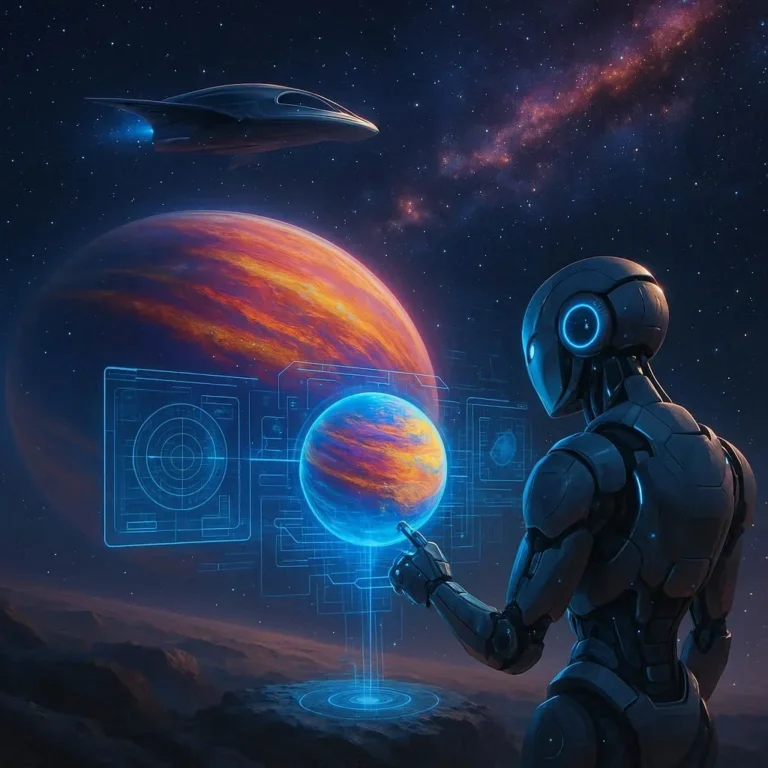
AI-Enhanced Space Navigation Algorithms
AI-Enhanced Space Exploration Robot Navigation Algorithms represent the frontier of autonomous exploration, marrying advanced machine learning capabilities with robust planetary navigation systems. These algorithms allow robotic rovers to interpret complex terrains, anticipate obstacles, and chart safe pathways with minimal human intervention, thus accelerating the pace of discovery across Mars, Europa, and beyond.
1. Foundations of Autonomous Terrain Mapping
At the core of AI‑enhanced navigation lies terrain mapping, a process by which robots translate raw sensor data into actionable terrain models. Sensors such as LIDAR, stereo cameras, and InSAR feed continuous point clouds into deep neural networks that classify surface features—regolith, cliffs, or subsurface ice—using convolutional architectures [[1](https://en.wikipedia.org/wiki/Convolutional_neural_network)].
The mapping pipeline combines traditional 3‑D reconstruction techniques with slight drift correction, a crucial step for missions spanning months to years. Drift arises from odometry errors and prolonged exposure to harsh radiation. Machine‑learning models identify repetitive patterns, enabling the rover to recalibrate its internal map against a stable reference frame, dramatically reducing cumulative error.
2. Simultaneous Localization and Mapping (SLAM) with Deep Reinforcement Learning
Simultaneous Localization and Mapping (SLAM) has long been a staple for Earth‑based robotics, but space missions demand a higher tolerance for uncertainty. Recent studies integrate deep reinforcement learning (DRL) into SLAM to enable dynamic replanning. In this framework, the rover’s policy network predicts actions that maximize future reward—potentially defined as scientific yield or energy efficiency—while the SLAM system updates the robot’s pose estimate.
This integration was demonstrated by NASA’s Mars 2020 mission, where the Perseverance rover employed a reinforcement‑learning‑augmented SLAM module to negotiate Martian gullies autonomously [[2](https://mars.nasa.gov/mars2020/multimedia/images/9032848/)].
3. Obstacle Detection and Collision Avoidance
AI‑enhanced obstacle detection uses a combination of feature‑based classifiers and instance‑segmentation models trained on synthetic datasets created by generative adversarial networks (GANs). The system predicts a probability map of obstacle surfaces within a 10‑m radius, feeding a cost‑based path planner that generates waypoints around hazards.
An example implementation is visible in the ESA Rosalind Franklin rover’s design, which utilizes a multi‑modal sensor suite for both optical and ultrasonic obstacle detection, enabling safe traversal across lunar regolith [[3](https://www.esa.int/Applications/Space_Engineering_Technology/Rosalind_Francis_rover)].
4. Energy‑Aware Path Planning for Long‑Duration Missions
Robotic missions must balance scientific objectives against limited power budgets. AI‑enhanced path planners incorporate forecasted solar irradiance and thermal models to modify routes in real time. Using a weighted cost function that penalizes high-energy paths, the planner chooses routes optimizing both safety and power use.
The Mars Science Laboratory rover employed a similar strategy, adjusting its daily itinerary based on an onboard weather model that predicted dust‑storm probability, thereby preserving battery health for critical experiments [[4](https://www.nasa.gov/centers/dryden/home/index.html)].
5. Safety Through Redundant AI Subsystems
Redundancy is a hallmark of reliable space systems. AI‑enhanced navigation architects deploy multiple independent models—a primary deep‑learning map updater and a physics‑based fallback controller—to ensure continued operation in case of model failure. These models converge via a Bayesian decision framework, training on real‑mission diagnostics to favor the most probable correct decision.
In practice, this layered approach was a decisive factor during the 2018 European Mars rover anomaly when a software glitch temporarily disabled the vision system, but the physical controller maintained safe navigation until the issue was resolved.
Conclusion: Toward Fully Autonomous Exploration
AI‑Enhanced Space Exploration Robot Navigation Algorithms are pushing the envelope of what autonomous rovers can achieve. By tightly integrating terrain mapping, DRL‑augmented SLAM, sophisticated obstacle avoidance, energy‑aware path planning, and redundant safety layers, these systems are turning robotic explorers from passive probes into intelligent agents capable of adaptive decision‑making on the fly. As computational hardware miniaturizes and machine‑learning models become more efficient, we can expect future missions to approach—and perhaps surpass—the autonomy of biological explorers.
Ready to unlock the next chapter of planetary discovery? Explore the cutting‑edge of autonomous rover technology today and join the mission to bring humanity closer to the stars.
Frequently Asked Questions
Q1. What are AI-Enhanced Space Navigation Algorithms and how do they differ from traditional methods?
AI-Enhanced Space Navigation Algorithms integrate deep learning, reinforcement learning, and sensor fusion to autonomously map, localize, and navigate planetary terrain with minimal human intervention. Unlike legacy systems that rely solely on pre‑flight maps and rule‑based planners, these algorithms continuously learn from perception data, adapt to novel obstacles, and optimize scientific value versus energy use.
Q2. How do these algorithms handle terrain mapping on planets like Mars and Europa?
They fuse LIDAR, stereo, and InSAR point clouds into dense reconstructions and use convolutional neural networks to classify surface types. Drift correction layers continuously rewrite the map against stable reference features, ensuring accurate navigation even after months of radiation‑induced error accumulation.
Q3. What role does deep reinforcement learning play in SLAM for space rovers?
Deep RL is embedded as the policy network that selects actions maximizing a reward that balances scientific yield and energy efficiency. It enables the rover to re‑plan its trajectory on‑the‑fly and guarantees safe navigation through unpredictable Martian gullies.
Q4. How do rovers balance energy constraints while navigating uneven terrain?
Energy‑aware planners incorporate real‑time solar irradiance forecasts and thermal models into a weighted cost function. This approach discourages high‑power climbs or passes during dust storms while still allowing essential scientific operations.
Q5. How is system redundancy achieved in AI navigation to avoid failures?
Multiple independent models—e.g., a neural map updater and a physics‑based fallback controller—operate in parallel. A Bayesian decision system selects the most probable correct action based on diagnostic data, ensuring the robot remains operational even if one component encounters a fault.
Related Articles

100+ Science Experiments for Kids
Activities to Learn Physics, Chemistry and Biology at Home
Buy now on Amazon
Advanced AI for Kids
Learn Artificial Intelligence, Machine Learning, Robotics, and Future Technology in a Simple Way...Explore Science with Fun Activities.
Buy Now on Amazon
Easy Math for Kids
Fun and Simple Ways to Learn Numbers, Addition, Subtraction, Multiplication and Division for Ages 6-10 years.
Buy Now on Amazon