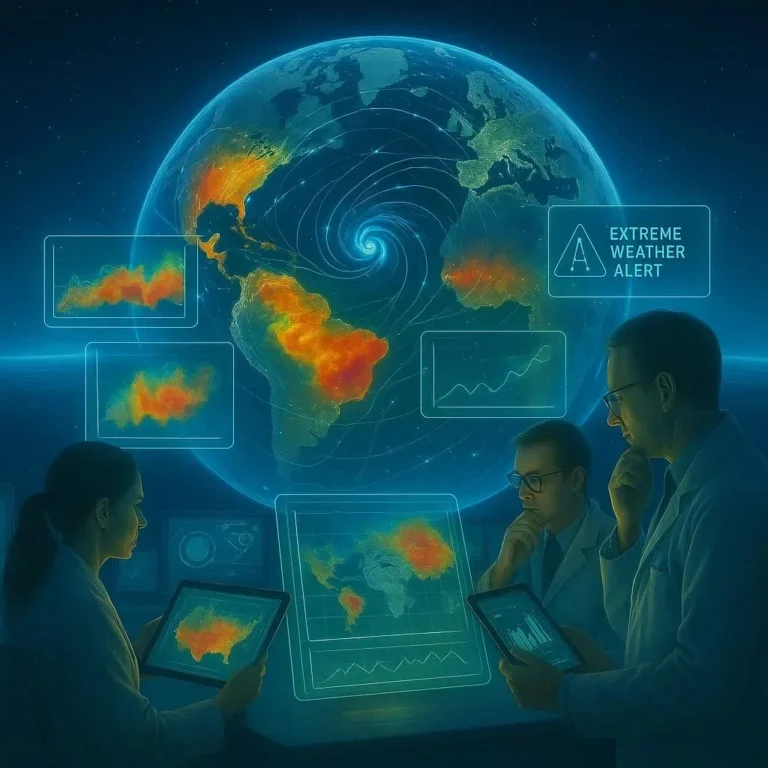
Satellite Innovations Transform Farming
Satellite innovations have rapidly shifted the traditional agrarian paradigm into a data‑driven era, offering farmers a panoramic vision of their fields like never before. By harnessing high‑resolution remote sensing from space, precision agriculture now benefits from real‑time insights into soil moisture, nutrient status, and plant health. These satellite‑derived metrics empower growers to apply water, fertilizer, and pesticides exactly where they are needed, reducing waste and boosting yields. Whether monitoring a sprawling commercial farm or a smallholder plot, satellite technology delivers consistent, planet‑scale coverage that adapts to every crop’s unique needs.
Revolutionizing Crop Monitoring
Modern satellites such as ESA’s Sentinel‑2 and NASA’s Landsat 8 provide multispectral imagery at 10‑30 m resolution, capturing land surface changes in near real‑time. These platforms monitor vegetation indices like NDVI (Normalized Difference Vegetation Index) and EVI (Enhanced Vegetation Index), offering farmers actionable data on canopy vigor. By combining cloud‑aware data processing pipelines with NOAA’s remote sensing services, agronomists can detect subtle crop stresses weeks before they become visually apparent on the ground.
High‑Resolution Imagery for Yield Prediction
Yield models increasingly rely on satellite imagery to calibrate forecasting tools. Statistical techniques such as machine learning regressions correlate past yield outcomes with spectral signatures captured during critical growth stages. For example, the presence of the green chromophore in the GNDVI (Green NDVI) signal has proven a reliable predictor of protein content in wheat. By feeding these indices into predictive algorithms, extension agents can issue site‑specific recommendations on optimal harvesting times and expected market prices. The USDA’s National Agricultural Statistics Service integrates satellite data into its yearly CropScape maps, enabling a broader view of regional production trends.
- Water‑use Efficiency: Precise irrigation scheduling reduces water consumption by up to 25% while maintaining yield levels.
- Targeted Fertilization: Variable rate fertilization lowers chemical inputs by 15–20% and cuts greenhouse gas emissions.
- Early Pest Detection: Remote sensing flags insect infestations before they devastate large areas.
- Resilience Assessment: Historical satellite archives track climate resilience and help plan adaptive crop rotations.
- Insurance Fraud Mitigation: Satellites verify crop damage claims, enhancing trust between insurers and farmers.
Integration with Farm Management Systems
Bridging satellite data with on‑field precision tools involves robust APIs and data formats like GeoJSON and KML. Platforms such as AgriTRACE ingest Sentinel‑2 data and overlay it with GPS‑enabled tractor guidance systems. This closed‑loop system allows a farmer to automatically adjust tillage depth or seed spacing in real time, aligning mechanical operations with the micro‑variability revealed by satellite imagery. Moreover, cloud‑based services like EcoWebApps provide user‑friendly dashboards where agronomists can visualize multi‑season trends and export them in formats compatible with enterprise resource planning (ERP) software.
Future Prospects and Challenges
Upcoming low‑Earth orbit constellations such as Planet Labs’ Dove and Space‑based hyperspectral missions promise sub‑meter resolution with daily revisit times, revolutionizing field‑level decision making. However, the sheer data volume raises significant processing challenges; satellite vendors are investing in on‑board AI that can pre‑filter anomalies before transmission. Data privacy remains a concern: while farmers benefit from detailed monitoring, the same imagery could be leveraged by agribusinesses to anticipate commodity prices. Ensuring equitable access to satellite data, such as through Copernicus Open Access Hub, will be critical for smallholder farmers worldwide.
Conclusion: Satellite innovations are no longer a luxury—they are the backbone of modern precision agriculture. By delivering granular, timely insights into plant health, soil conditions, and environmental stresses, they empower growers to optimize input usage, safeguard yields, and reduce their ecological footprint. Whether you’re a large‑scale operation or a smallholder looking to adopt data‑driven practices, satellite‑enabled decision platforms are the catalyst for sustainable growth.
Frequently Asked Questions
Q1. What are the primary benefits of satellite innovations in farming?
Satellite innovations offer farmers real‑time, high‑resolution insights into soil moisture, nutrient status, and plant health. This data enables precise application of water, fertilizer, and pesticides, reducing waste and costs while boosting yields. Additionally, satellites provide consistent, planet‑scale coverage that is invaluable for monitoring large or remote fields.
Q2. Which satellites are most commonly used for precision agriculture?
ESA’s Sentinel‑2 and NASA’s Landsat 8 are among the most widely used platforms. Sentinel‑2 delivers multispectral imagery at 10–30 m resolution with frequent revisit times, while Landsat 8 provides long‑term data with 30 m resolution and is freely available. These satellites capture vegetation indices like NDVI and EVI that are critical for crop monitoring.
Q3. How can satellite data help smallholder farmers?
Smallholder farms can access free or low-cost satellite data through platforms such as Copernicus Open Access Hub and Google Earth Engine. By integrating this data with simple mobile apps, smallholders can detect early pest outbreaks, optimize irrigation schedules, and plan crop rotations, ultimately increasing resilience and profitability.
Q4. What challenges exist in using satellite imagery for farming?
The main challenges include data volume management, reliance on cloud cover for optical sensors, and the need for specialized software to process and interpret the data. Privacy concerns also arise, as detailed imagery can reveal proprietary farm practices. Overcoming these hurdles requires investment in cloud computing, user‑friendly dashboards, and clear data‑sharing agreements.
Q5. What future satellite developments could further enhance precision agriculture?
Upcoming constellations like Planet Labs’ Dove and hyperspectral missions promise sub‑meter resolution with daily revisit times, allowing field‑level decision making in near real‑time. On‑board AI and edge computing are also being developed to pre‑filter anomalies before data transmission, reducing processing loads on the ground.
Related Articles

100+ Science Experiments for Kids
Activities to Learn Physics, Chemistry and Biology at Home
Buy now on Amazon
Advanced AI for Kids
Learn Artificial Intelligence, Machine Learning, Robotics, and Future Technology in a Simple Way...Explore Science with Fun Activities.
Buy Now on Amazon
Easy Math for Kids
Fun and Simple Ways to Learn Numbers, Addition, Subtraction, Multiplication and Division for Ages 6-10 years.
Buy Now on Amazon