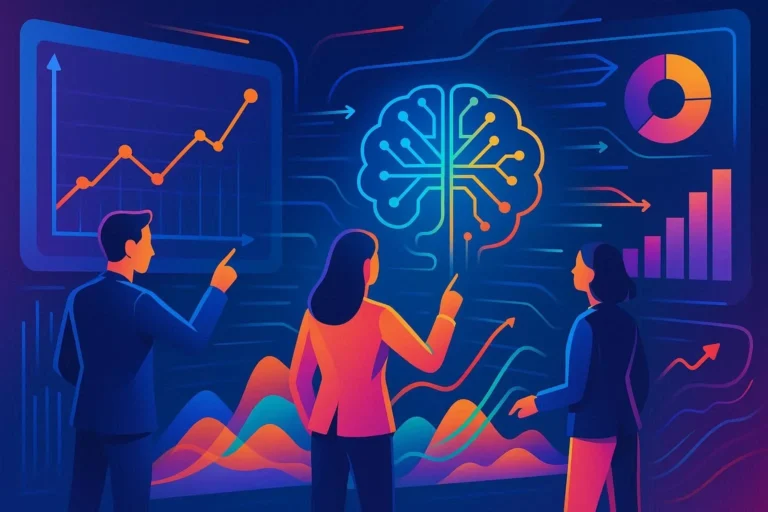
AI in Climate Modeling Energy
In the evolving landscape of renewable energy planning, the integration of AI in Climate Modeling is proving to be a transformative force. Accurate weather forecasts and climate projections are essential for the design and operation of wind farms, solar arrays, and energy storage systems. By leveraging machine learning algorithms, researchers can refine climate models, reduce uncertainties, and provide more actionable insights for energy developers and policymakers alike.
Why AI Enhances Climate Modeling
Traditional climate models rely on physics-based equations to simulate the Earth’s atmosphere, oceans, and land surface. While these models are robust, they face challenges such as high computational costs and limited resolution. AI in Climate Modeling fills these gaps by discovering patterns in vast datasets, effectively learning sub-grid processes, and accelerating simulations. The result is a higher-resolution climate forecast that captures micro-scale phenomena—critical for localized renewable energy projects.
Key Machine Learning Techniques
Several AI methodologies are now routine in climate science. Below is a concise list of techniques that are shaping the future of renewable planning:
- Convolutional Neural Networks (CNNs) – excel at processing spatial data, such as satellite imagery of cloud cover.
- Gaussian Processes – provide probabilistic predictions useful for risk assessment.
- Deep Reinforcement Learning – optimizes adaptive control strategies for power grids.
- Transfer Learning – allows models trained on one climate regime to adapt to another, reducing data requirements.
- Generative Adversarial Networks (GANs) – generate realistic fine-grained weather scenarios for scenario planning.
For instance, the European Centre for Medium-Range Weather Forecasts (ECMWF) has incorporated CNNs to refine precipitation forecasts, cutting computational time by up to 30%. This synergy between AI and physical modeling not only speeds up analysis but also enhances the granularity of the results.
Case Studies in Renewable Planning
Several real-world deployments illustrate the tangible benefits of AI in Climate Modeling for renewable energy:
- Solar Farm Site Selection in California – A joint effort between the National Renewable Energy Laboratory (NREL) and the University of California used GANs to generate high-resolution irradiance maps. This improved project feasibility studies by 18%.
- Wind Energy Forecasting in New England – The U.S. Department of Energy (DOE) partnered with a private AI firm to deploy a deep reinforcement learning algorithm that tunes turbine pitch control in real-time, boosting energy yield by 7%.
- Grid Stability in Brazil – Researchers at the University of São Paulo applied Gaussian Processes to predict load-and-generation mismatches during extreme weather events, enabling the grid operator to pre-position battery storage and minimize outage risks.
These examples show that AI does not replace traditional climate physics; rather, it amplifies our ability to harness renewable resources more efficiently.
Challenges and Ethical Considerations
Despite its promise, AI in Climate Modeling faces several hurdles:
- Data Quality – Machine learning thrives on high-quality, representative data. Incomplete or biased datasets can lead to misleading predictions.
- Interpretability – Decision-makers often demand explainable models, but deep learning architectures can be opaque. Hybrid physics-AI models help bridge this gap.
- Computational Equity – Advanced AI tools require substantial energy and hardware, potentially widening disparities between high-income countries and emerging economies.
- Ethical Use of Climate Knowledge – Forecasts influence investment decisions that can have long-term social impacts; responsible stewardship is vital.
Addressing these challenges involves interdisciplinary collaboration, open data initiatives, and policy frameworks that promote transparency and equitable access to AI-driven climate insights.
Conclusion and Call to Action
AI in Climate Modeling Energy is no longer a theoretical concept; it’s a practical tool reshaping how we design, operate, and optimize renewable energy assets. By embracing AI-enhanced climate forecasts, developers can reduce risk, accelerate deployment, and increase the share of clean energy on the grid.
We invite researchers, engineers, and policymakers to collaborate on open-source AI climate modules, share high-resolution datasets, and integrate these tools into national energy strategies. Together, we can accelerate the transition to a sustainable, resilient energy future where predictions guide decisions, not uncertainty.
Join the Movement – Explore the latest AI climate datasets, contribute to open-source projects, and help shape equitable energy planning. Reach out to your local research institutions or energy agencies today, and let’s build a brighter, data-driven tomorrow.
Interested in learning more? Visit authoritative resources such as the Intergovernmental Panel on Climate Change, the National Oceanic and Atmospheric Administration, or the Wikipedia entry on Climate Change for foundational science.
Frequently Asked Questions
Q1. How does AI improve climate modeling for renewable energy projects?
AI augments traditional physics‑based models by learning sub‑grid processes from massive observational datasets, thereby reducing computational costs and increasing resolution. Machine learning algorithms can identify subtle patterns in weather and terrain data that enhance forecast accuracy, especially for micro‑scale events critical to wind and solar siting. The result is faster, more reliable climate projections that enable developers to plan with greater confidence and lower risk.
Q2. What machine learning techniques are commonly used in climate science?
Convolutional Neural Networks (CNNs) handle spatial data like satellite imagery; Gaussian Processes offer probabilistic estimates useful for risk analysis; Deep Reinforcement Learning optimizes grid control; Transfer Learning adapts models across climates; and Generative Adversarial Networks (GANs) create high‑resolution weather scenarios. These methods complement physics‑based models and accelerate simulation cycles.
Q3. Can you give examples of real‑world deployments?
California solar farms used GANs to generate detailed irradiance maps, improving feasibility studies by 18%. In New England, a DOE partnership deployed a reinforcement‑learning algorithm that tunes turbine pitch, boosting yield by 7%. The University of São Paulo applied Gaussian Processes to predict load‑generation mismatches during extreme weather, allowing pre‑positioning of batteries and reducing outages.
Q4. What challenges exist with AI in climate modeling?
Data quality, including biases and gaps, can skew model outputs; interpretability remains an issue for deep neural nets, demanding hybrid physics‑AI approaches; and the high computational energy and hardware requirements risk widening resource inequities. Ethical considerations also arise, as forecasts drive investment decisions with long‑term social impacts.
Q5. How can stakeholders contribute to AI climate modules?
Researchers can share high‑resolution datasets through open‑source repositories, develop and publish open‑source AI modules, and collaborate across disciplines to improve interpretability. Policymakers can fund open‑access projects and promote transparent data governance, while industry partners can integrate AI tools into planning pipelines and provide real‑world validation datasets.
Related Articles

100+ Science Experiments for Kids
Activities to Learn Physics, Chemistry and Biology at Home
Buy now on Amazon
Advanced AI for Kids
Learn Artificial Intelligence, Machine Learning, Robotics, and Future Technology in a Simple Way...Explore Science with Fun Activities.
Buy Now on Amazon
Easy Math for Kids
Fun and Simple Ways to Learn Numbers, Addition, Subtraction, Multiplication and Division for Ages 6-10 years.
Buy Now on Amazon