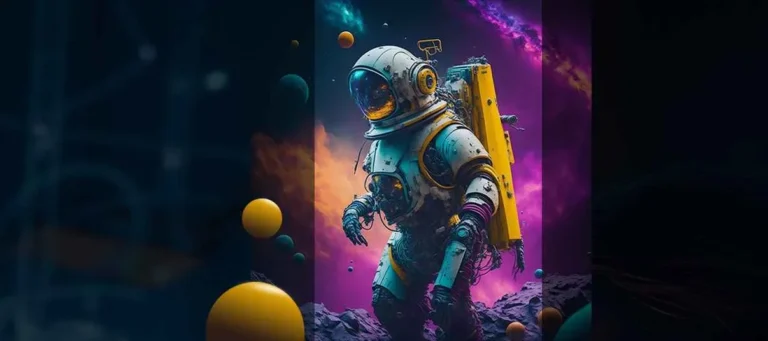
AI-Driven Space Probe Control
Artificial intelligence is increasingly becoming the backbone of modern space missions, guiding probes through the unforgiving environment of space with unprecedented autonomy and precision. AI‑driven control systems empower probes to make real‑time decisions, adapt to unforeseen challenges, and optimize resource usage, all while maintaining stringent safety and scientific requirements. In this article we explore how AI is reshaping spacecraft control, the technologies driving these advances, and real‑world examples that illustrate the transformative potential of intelligent autonomy.
Why AI is Essential for Space Exploration
The harsh, data‑rich, and time‑critical nature of deep‑space missions demands control systems that can learn, adapt, and operate with minimal human intervention. Spacecraft travel millions of kilometers, experiencing radiation, extreme temperatures, and sparse communication windows. Traditional command‑and‑control architectures, which rely on pre‑programmed flight plans and ground‑based decision loops, struggle to cope with these constraints. AI introduces predictive analytics, fault detection, and re‑planning capabilities that can respond within milliseconds, preserving mission integrity and enabling more ambitious scientific goals.
Core AI Technologies in Space Probe Control
The integration of AI in spacecraft is not a single monolithic solution but a suite of interlocking technologies. The most prominent among these are:
- Reinforcement Learning – Agents learn optimal actions through simulated environments that mimic real mission conditions. NASA’s Spacecraft Flight Software prototypes have demonstrated reinforcement‑learning algorithms managing attitude control during complex maneuvers.
- Deep Neural Networks (DNNs) – Convolutional nets process telemetry streams, imaging data, and sensor arrays to detect anomalies in real time. The European Space Agency’s Deep Learning for Space project showcases DNNs autonomous monitoring of propulsion health.
- Probabilistic Graphical Models – Bayesian approaches fuse uncertain sensor data, enabling robust decision making under incomplete information, essential for navigation when external reference signals are weak.
- Edge‑AI Inference Chips – Hardware like NVIDIA’s Jetson Xavier brings high‑performance, low‑power inference to onboard computers, allowing continuous AI processing without exhausting limited energy budgets.
Autonomous Anomaly Detection and Recovery
One of the most critical safety requirements for space probes is rapid anomaly detection. Traditional systems flag anomalies based on hard thresholds and trigger preset mitigation sequences. AI, by contrast, learns normal operational patterns and identifies subtle deviations that may herald more severe issues. For instance, the Perseverance rover uses machine‑learning algorithms to monitor the louvers of its power module, preventing overheating before it becomes catastrophic.
Beyond detection, AI can autonomously devise mitigation strategies. Reinforcement‑learning agents can re‑sequence power loads or adjust attitude missions to preserve critical instruments, substantially reducing the need for ground intervention during prolonged communication gaps.
Dynamic Re‑Planning and Environmental Adaptation
Space is an unpredictable environment. Solar flares can burst, dust storms can obscure instruments, and the relative positions of celestial bodies change. AI‑driven planners continuously re‑evaluate mission objectives against real‑time data, generating new flight plans that balance scientific return against fuel consumption and risk.
For example, the Mars Express orbiter employs an adaptive trajectory optimization module that recalculates entry, descent, and landing (EDL) maneuvers based on real‑time atmospheric data. This adaptive control saves precious propellant and increases landing success rates.
Onboard Data Prioritization and Science Yield Optimization
Telemetry bandwidth is a finite resource; probes can only transmit a fraction of their collected data back to Earth. AI can predict which data sets will yield the highest scientific value, automatically flagging observations for higher transmission priority.
During the Galileo mission, an onboard AI module evaluated high‑resolution images of Io and prioritized those showing volcanic activity, ensuring that key opportunities were not missed due to bandwidth constraints.
Future Outlook: Fully Autonomous Deep‑Space Missions
Looking ahead, the trend is clear: robotic missions will become more autonomous, reducing the mission control burden and enabling longer, more complex voyages. The Artemis I lunar launcher, the planned Dragonfly rotorcraft to Titan, and several planned interstellar probes all feature AI control architectures that prioritize autonomy to cope with deep‑space latencies.
Technical hurdles remain. Computational constraints, radiation hardening of GPUs, and the need for formal verification of AI decision logic are active research areas. Yet the convergence of machine learning, high‑performance on‑board hardware, and robust simulation frameworks is steadily moving us toward truly self‑learning probes capable of charting the unknown with minimal human oversight.
Conclusion & Call to Action
AI‑driven control systems are no longer a future aspiration but a current reality shaping the next era of space exploration. By enabling real‑time anomaly handling, dynamic replanning, and intelligent data management, these systems free mission designers to pursue bold scientific objectives that would otherwise be impossible.
If you are involved in aerospace research, engineering, or simply share a passion for the stars, now is the time to dive deeper into the intersection of artificial intelligence and space exploration. Engage with our community, attend upcoming workshops on Space AI, and stay informed on the latest breakthroughs that are redefining our place in the cosmos.
Join the conversation and help guide the future of autonomous space probes!
Frequently Asked Questions
Q1. How does AI improve space probe autonomy?
AI enables real‑time decision making by learning from simulated and actual mission data. It can adapt to unexpected events, re‑plan trajectories, and manage resources without constant ground intervention.
Q2. What AI technologies are most common in spacecraft?
Key technologies include reinforcement learning for control policies, deep neural networks for anomaly detection, probabilistic models for sensor fusion, and edge‑AI inference chips that run efficiently on‑board.
Q3. Can AI handle critical faults autonomously?
Yes. AI can detect subtle deviations early, predict fault progression, and devise mitigation strategies—such as power re‑sequencing or attitude adjustments—before a fault becomes catastrophic.
Q4. How does AI prioritize scientific data for transmission?
By evaluating data streams against historical scientific value and current mission goals, AI flags the most significant observations for higher‑priority transmission, optimizing limited bandwidth.
Q5. What are the biggest challenges for AI in deep‑space missions?
Challenges include limited computational resources, radiation hardening of AI hardware, and ensuring formal verification of autonomous decision logic to meet strict safety requirements.
Related Articles

100+ Science Experiments for Kids
Activities to Learn Physics, Chemistry and Biology at Home
Buy now on Amazon
Advanced AI for Kids
Learn Artificial Intelligence, Machine Learning, Robotics, and Future Technology in a Simple Way...Explore Science with Fun Activities.
Buy Now on Amazon
Easy Math for Kids
Fun and Simple Ways to Learn Numbers, Addition, Subtraction, Multiplication and Division for Ages 6-10 years.
Buy Now on Amazon