AI Space Weather Mitigation
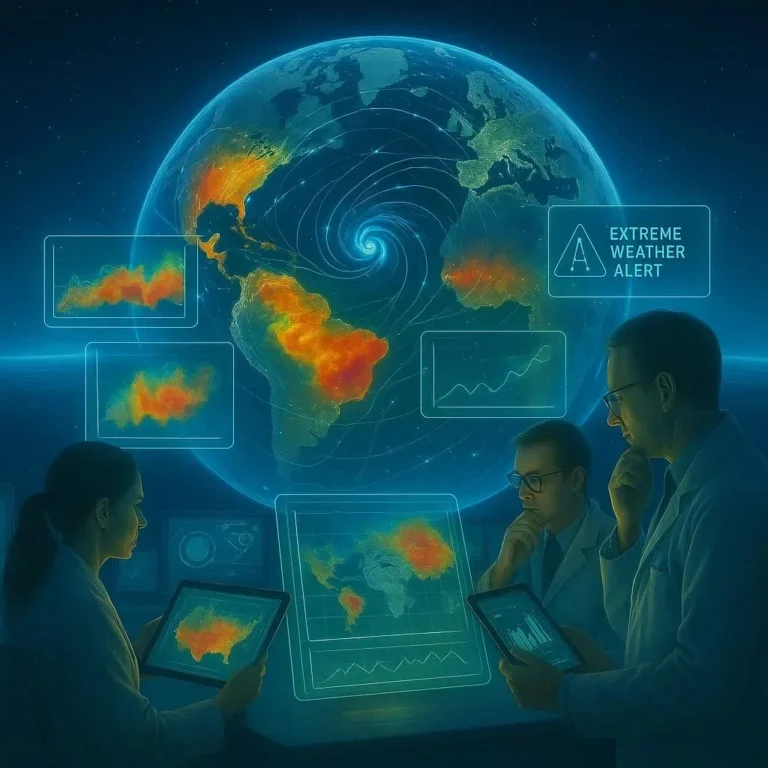
Artificial intelligence (AI) has become an indispensable tool in the quest to understand and mitigate space weather impacts on modern technology. By harnessing massive data streams from satellites, ground‑based observatories, and solar probes, AI systems can detect, predict, and mitigate the effects of solar flares, coronal mass ejections, and geomagnetic storms that threaten satellite operations, power grids, and aviation safety.
AI Space Weather Impact Detection
One of the first challenges in space weather science is recognizing the signatures of potentially dangerous solar events in real time. Traditional threshold‑based alerts can miss subtle precursors or produce false alarms. AI excels at pattern recognition, allowing it to sift through terabytes of data from the Solar Dynamics Observatory (SDO), the Solar and Heliospheric Observatory (SOHO), and the Magnetospheric Multiscale Mission (MMS) to identify early signs of instability. Machine‑learning classifiers trained on historical flare catalogs can assign probabilities to each observation, providing nuanced risk assessments that exceed the capabilities of simple rule‑based systems.
AI in Space Weather Data Collection
Quantity and quality of input data are crucial for reliable forecasts. AI-augmented sensor networks automatically calibrate instruments, flag anomalies, and even predict instrumental drift before it compromises data integrity. Autonomous satellite platforms use onboard AI to prioritize observations, ensuring that key metrics—such as solar wind velocity, ion (O⁺) densities, and magnetic field vectors—are captured even when data bandwidth is limited. These intelligent data pipelines form the backbone of downstream analytical models.
Predictive Modeling with Machine Learning
Once clean, high‑fidelity datasets are available, AI can build predictive models that mimic the physics of the heliosphere. Deep neural networks (DNNs) and recurrent neural networks (RNNs) have been employed to forecast heliospheric current sheet orientations, auroral electrojet strengths, and ionospheric total electron content (TEC). For example, convolutional neural networks (CNNs) trained on solar magnetogram images can forecast flare occurrences within a 24‑hour window, while graph neural networks (GNNs) map interplanetary magnetic field connectivity to terrestrial magnetospheric responses.
- Flare probability forecasting – leveraging image‑based CNNs.
- Geomagnetic storm intensity prediction – using RNNs on solar wind time series.
- Ionospheric disturbance mapping – GPT‑style language models ingesting global TEC maps.
- Satellite anomaly forecasting – predictive maintenance using LSTM networks.
These modeling approaches outperform classical physics‑based models in certain regimes, particularly where data sparsity or nonlinearities limit analytic solutions. Moreover, AI models provide probabilistic outputs that quantify forecast confidence, enabling operators to balance precautionary actions with operational continuity.
Real‑Time Response Systems
Beyond prediction, AI technologies facilitate rapid response. Fleet management algorithms assess in‑flight telemetry and recommend trajectory adjustments for satellites encountering elevated radiation fluxes. Power grid operators use AI dashboards that compare incoming space weather alerts with electrical load profiles, automating transformer triage and load shedding strategies to safeguard against geomagnetically induced currents (GICs). Commercial airlines employ AI‑driven flight‑level adjustments to mitigate high‑altitude radiation exposure for crew and passengers during solar particle events.
In all these scenarios, AI is the bridge between actionable insight and timely mitigation. By integrating open‑source compound databases with proprietary performance metrics, the industry is moving toward a standardized, interoperable AI ecosystem for space weather resilience.
Looking Ahead: AI and Global Space Weather Infrastructure
Future efforts are geared toward establishing a global AI‑enabled monitoring network. Initiatives such as the International Space Environment Service (ISEE) aim to unify observational archives, while collaborative projects between NASA, NOAA, and European Space Agency (ESA) are experimenting with distributed AI training on federated datasets. Emerging technologies—edge computing, quantum machine learning, and neuromorphic hardware—are expected to reduce latency further and empower autonomous planetary defense.
Conclusion and Call to Action
AI’s transformative impact on space weather mitigation is clear: enhanced detection, precise forecasting, and efficient real time response to protect satellites, power grids, and aviation. To stay ahead, stakeholders—government agencies, industry leaders, and academia—must continue investing in AI research, share transparent datasets, and adopt best practices for model validation. Embrace AI tools now, and build a future where humanity—and our technology—thrives under the unpredictable influence of the Sun.
Ready to strengthen your space weather resilience? Partner with leading AI‑space weather firms, adopt cloud‑based forecasting suites, and contribute to open‑source research. Take proactive steps today.
For deeper insights, explore NASA’s space weather guide (NASA Space Weather), NOAA’s Space Weather Prediction Center (NOAA SWPC), and the space weather overview on Wikipedia (Space Weather).
Frequently Asked Questions
Q1. What is AI Space Weather Mitigation?
AI Space Weather Mitigation refers to the use of artificial intelligence techniques to detect, forecast, and respond to space weather events such as solar flares, coronal mass ejections, and geomagnetic storms. By leveraging large datasets from satellites and ground-based observatories, AI models can identify subtle precursors and predict their impacts on modern technology. The goal is to reduce damage to satellites, power grids, and aviation by enabling timely protective actions.
Q2. How does AI improve the detection of solar flares?
Traditional threshold‑based monitoring can miss early signs or generate false alarms. AI employs pattern‑recognition algorithms—CNNs on magnetogram images, RNNs on solar‑wind time series—to sift through terabytes of data in real time. These models assign probability scores to each observation, giving a nuanced risk assessment that outperforms rule‑based systems.
Q3. Which industries benefit most from AI space weather forecasts?
The satellite operator, power‑grid managers, airline regulators, and telecommunications firms are the primary beneficiaries. AI‑driven alerts allow satellite fleets to adjust orbits, grid operators to pre‑emptively shed load, airlines to alter flight paths, and telecom networks to reallocate bandwidth, thereby minimizing downtime and costly repairs.
Q4. What AI techniques are most commonly used in space weather prediction?
Deep neural networks (DNNs) and recurrent neural networks (RNNs) forecast solar‑wind conditions; convolutional neural networks (CNNs) analyze images for flare probability; graph neural networks (GNNs) map magnetic connectivity; long‑short‑term memory (LSTM) models predict satellite anomalies; and transformer‑style language models ingest global ionospheric TEC maps for disturbance mapping.
Q5. How can organizations begin integrating AI into their space weather resilience plans?
Organizations should first assemble clear, high‑quality data from observatories and satellites, then collaborate with open‑source AI communities or commercial providers. Validation against historical events, continuous retraining with new data, and establishing governance for model interpretability are essential steps before deployment in operational environments.
Related Articles

100+ Science Experiments for Kids
Activities to Learn Physics, Chemistry and Biology at Home
Buy now on Amazon
Advanced AI for Kids
Learn Artificial Intelligence, Machine Learning, Robotics, and Future Technology in a Simple Way...Explore Science with Fun Activities.
Buy Now on Amazon
Easy Math for Kids
Fun and Simple Ways to Learn Numbers, Addition, Subtraction, Multiplication and Division for Ages 6-10 years.
Buy Now on Amazon