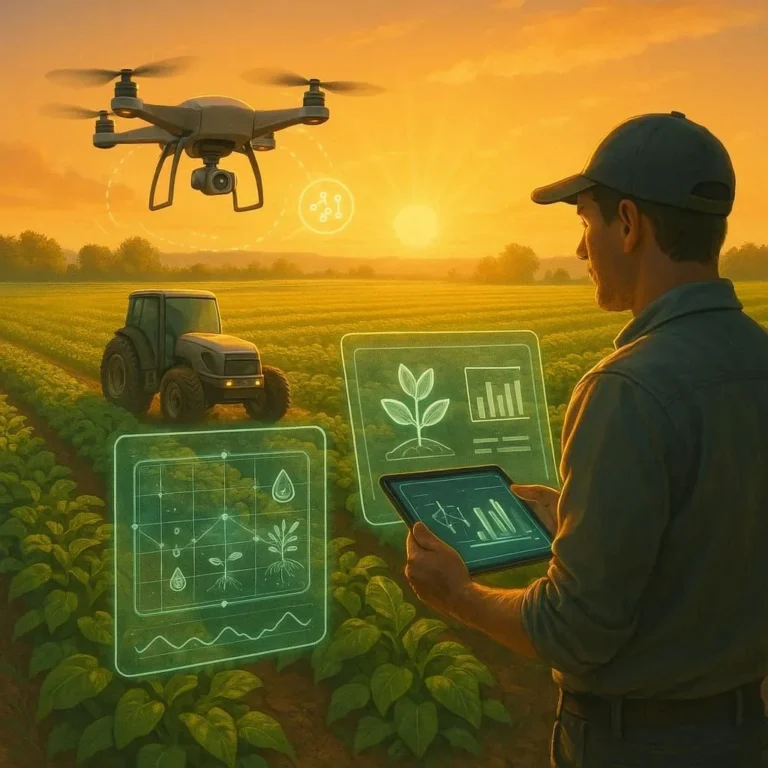
AI in Precision Agriculture
Artificial Intelligence (AI) in precision agriculture is transforming how farmers monitor crops, manage resources, and boost yields. By combining satellite images, soil sensors, and farm‑management software, AI analyzes vast data sets in real time, offering actionable insights that help optimize planting schedules, irrigation, and pest control. As global food demand climbs, the adoption of AI in precision agriculture becomes increasingly vital for sustainable, high‑yield farming practices.
AI in Precision Agriculture: Real‑Time Crop Monitoring
Modern fields are equipped with drones, ground‑based sensors, and high‑resolution satellites that generate continuous streams of data. AI algorithms process imagery to detect early warning signs such as nutrient deficiencies, water stress, or pathogen outbreaks. By instantly identifying problem areas, growers can target interventions with pinpoint accuracy, reducing both chemical usage and costs.
- Lowered fertilizer runoff by up to 30%
- Improved early detection of fungal diseases
- Higher overall crop resilience
For a deeper dive, the Precision Agriculture Wikipedia page outlines the foundational technologies driving these advancements.
AI in Precision Agriculture: Soil Health Prediction
Soil sensors capture moisture, temperature, and electrical conductivity, feeding data into AI models that forecast optimal planting times and crop varieties suited to local conditions. The resulting decisions improve seed placement and reduce erosion, contributing to long‑term soil fertility. Researchers at LSU Agriculture demonstrate that AI‑guided soil profiling can increase yields by 15–25% while cutting inputs.
AI in Precision Agriculture: Intelligent Irrigation Management
Water scarcity is a pressing concern globally. AI integrates weather forecasts, evapotranspiration models, and real‑time plant water stress indicators to automate irrigation systems. The outcome is water savings of 20–40% without compromising yield, a game‑changer for farms operating in arid regions. The United States Department of Agriculture (USDA) supports these initiatives with guidelines for smart irrigation.
AI in Precision Agriculture: Pest and Disease Forecasting
Predictive analytics use pattern recognition to anticipate pest infestations before they become severe. By cross‑referencing climate data, crop health images, and historical pest activity, AI models provide farmers with advance notice and strategic intervention plans. This proactive approach, detailed in a recent Nature article, reduces pesticide reliance and protects ecosystem balance.
AI in Precision Agriculture: Cost‑Effective Resource Allocation
Farm management software powered by AI consolidates yields, input costs, and labor metrics into a single dashboard. Decision‑makers can allocate budget toward high‑return initiatives and eliminate wasteful practices. The Food and Agriculture Organization (FAO) reports that AI adoption can improve farm profitability by up to 18% in emerging markets.
Conclusion: Embrace AI in Precision Agriculture Today
AI in precision agriculture is no longer a futuristic concept but a tangible tool that offers measurable benefits—improved yields, resource conservation, and environmental stewardship. Farmers who integrate AI-driven insights into their operational strategy will not only maximize profits but also contribute to sustainable food systems worldwide. Ready to experience higher yields and smarter field management? Reach out now for a personalized AI in precision agriculture solution.

100+ Science Experiments for Kids
Activities to Learn Physics, Chemistry and Biology at Home
Buy now on Amazon
Advanced AI for Kids
Learn Artificial Intelligence, Machine Learning, Robotics, and Future Technology in a Simple Way...Explore Science with Fun Activities.
Buy Now on Amazon
Easy Math for Kids
Fun and Simple Ways to Learn Numbers, Addition, Subtraction, Multiplication and Division for Ages 6-10 years.
Buy Now on Amazon