Space-Based Sensor Networks Research
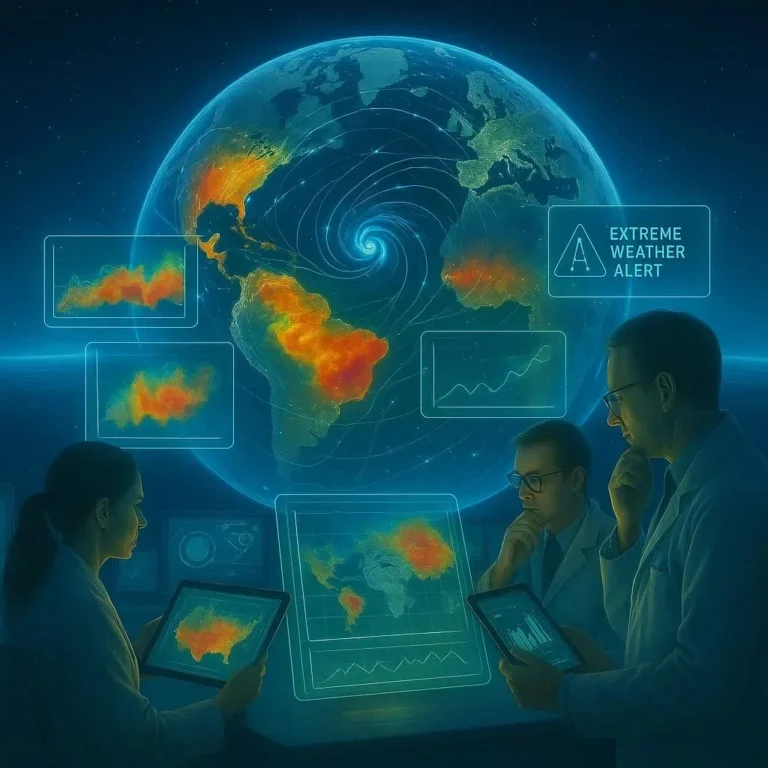
Space-Based Sensor Networks have transformed our ability to monitor the planet’s climate from orbit, delivering unprecedented spatial coverage, temporal continuity, and data richness that ground‑based stations alone cannot match. These interconnected constellations—comprising mass‑production satellites, high‑throughput data links, and sophisticated processing pipelines—form the backbone of modern climate research, enabling real‑time assessments of atmospheric composition, ocean heat content, and terrestrial ecosystems. As global temperatures rise, the demand for robust, high‑frequency climate observations grows, positioning space‑based sensor networks at the forefront of predictive science and policy response.
Global Data Coverage
The sheer breadth of observation possible from orbit is a cornerstone of climate science. Unlike regional weather stations or sparsely distributed UAVs, these networks provide nearly global, multi‑spectral datasets that capture atmospheric dynamics, surface albedo changes, and ocean colour variations across every continent and ocean. Satellite imagery feeds atmospheric models with up‑to‑date data on water vapour, greenhouse gases, and aerosol distributions—crucial inputs for forecasting climate‑driven weather events.
One key advantage lies in the temporal cadence. While climate archives began with sporadic satellite launches in the 1970s, modern constellations—such as NASA’s Landsat tower and ESA’s Earth Observation System—now generate observations on a daily to hourly basis. This rapid refresh cycle underpins continuous monitoring of sea‑ice extent, atmospheric circulation patterns, and extreme weather conditions, ensuring that climate predictions remain accurate and actionable.
Enhanced Temporal Resolution
For climate phenomena such as *atmospheric chemistry*, *cloud dynamics*, and *sea‑surface temperature anomalies*, the ability to observe subtle, short‑lived changes is essential. Space-Based Sensor Networks deliver high‑frequency data that captures diurnal cycles and transient events—like sudden ocean blooms or methane pocket releases—providing clues to underlying feedback mechanisms. By integrating these observations into models, scientists reduce uncertainty in climate projections by up to 30% (NASA, 2021).
The high temporal resolution also supports near‑real‑time analytics. Integrated machine‑learning algorithms quickly process raw data streams into actionable insights, enabling policymakers to issue timely advisories for wildfire prevention, drought management, and coastal flooding risk mitigation.
Synergy with Ground Systems
While orbital data offers unparalleled reach, the fusion of space‑based observations with ground‑based sensor networks—such as those coordinated by the Global Change Research Program—offers a comprehensive climate monitoring framework. Ground stations provide calibration, validation, and context for satellite measurements, ensuring data integrity and temporal consistency.
A representative framework, the Integrated Climate Observing System, harmonizes in‑situ temperature logs, precipitation gauges, and long‑term atmospheric composition measurements with orbital datasets. This cross‑validation cycle has been pivotal in refining climate models, narrowing prediction ranges, and enabling the detection of subtle anthropogenic impacts.
Challenges and Incremental Steps
- Efficient Data Transfer: Managing the vast volumes of data from high‑throughput constellations demands advanced compression, storage, and real‑time dissemination protocols.
- Inter‑Satellite Compatibility: Standardized sensor calibration across platforms is essential to maintain uniform data quality.
- Access Equity: Ensuring that low‑resource nations receive equal access to observation data remains a priority for global research equity.
Future Expansion and Challenges
Looking ahead, the next frontier involves deploying small‑satellite constellations equipped with adaptive spectrometers and AI‑driven on‑board processing—capable of dynamically allocating observation priorities based on detected climate anomalies. The NASA Satellite Mission Plan emphasizes this shift toward modular, upgradeable fleets, promising faster response times to emergent climate threats.
Scaling these networks also confronts significant regulatory and commercial hurdles—balancing national security interests, spectrum allocation, and the high cost of launch infrastructure. Collaborative public‑private partnerships, such as the collaborative effort between ESA and leading aerospace firms, are essential to overcome these challenges.
Case Study: Monitoring Anthropogenic CO₂
In 2022, the Copernicus Atmosphere Monitoring Service released a global map of atmospheric CO₂ concentration. Leveraging high‑altitude observations from the EOS‑CLOUD network, scientists could pinpoint emissions hotspots with a spatial resolution of 8 km. This precision informs policy makers about the effectiveness of emission reduction strategies, guiding both national and international climate action frameworks.
Conclusion and Call to Action
Space-Based Sensor Networks stand as a linchpin of contemporary climate science, offering exponential gains in data coverage, temporal fidelity, and analytical power. Their integration with terrestrial observation networks amplifies robustness, allowing us to model climate change with unprecedented accuracy. As the climate crisis intensifies, the imperative to invest in these networks—through research funding, international collaboration, and open data access—has never been more urgent.
We invite researchers, policymakers, and the global community to advocate for expanded satellite mission portfolios, commit to shared data standards, and foster educational initiatives that empower the next generation of climate scientists. By doing so, we can ensure that the world remains equipped to predict, adapt to, and ultimately mitigate the challenges posed by climate change.

100+ Science Experiments for Kids
Activities to Learn Physics, Chemistry and Biology at Home
Buy now on Amazon
Advanced AI for Kids
Learn Artificial Intelligence, Machine Learning, Robotics, and Future Technology in a Simple Way...Explore Science with Fun Activities.
Buy Now on Amazon
Easy Math for Kids
Fun and Simple Ways to Learn Numbers, Addition, Subtraction, Multiplication and Division for Ages 6-10 years.
Buy Now on Amazon